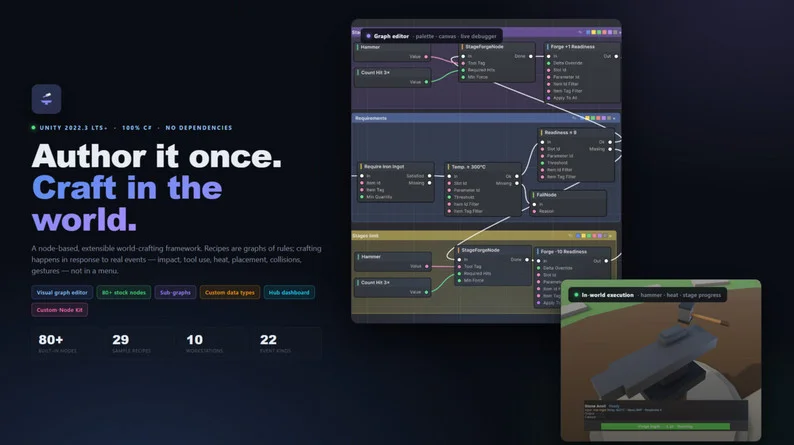
World Craft Graph turns crafting from a menu interaction into a physical world event. The player doesn't open an interface — they hit, crush, heat, combine. As a developer, you describe the rules of those transformations as a visual graph, without writing a single line of code.
Show full description...
Drop three stones next to each other. Hit them with a sledgehammer. If the conditions match, the stones disappear and a stone slab appears in their place. This isn't a hand-written script. It's a graph of rules that fires because the world dispatched an impact event, the system found a matching recipe, and applied it.
That's how all crafting works in World Craft Graph: rules instead of recipes, the world instead of menus, events instead of buttons.
Features
- Visual graph editor. A full node editor with node categories, search, validation, and clear execution tracing.
- Event-driven architecture. Impact, tool use, placement, heating, crushing, mixing, ignition, timers, custom events — all extensible.
- Flexible item model. ScriptableObject definitions, runtime components, dynamic properties, timed states, tags.
- Rich node palette. Queries, filters, conditions, logic, modifiers, actions, outputs — everything needed for non-trivial recipes.
- Conflict resolution. When multiple graphs match an event, the system picks by priority or specificity — strategies are extensible.
- Extensibility API. Add your own event, condition, modifier and action nodes without touching the core.
- Debugging out of the box. Execution tracing answers: which graph ran, why, where it failed, which items were selected.
- Demo scenes and ready-made recipes. Stone slab, herb powder, primitive axe and more.
Who it's for
- Survival and crafting games where crafting is an action in the world, not a journal entry.
- Immersive sims where items react to tools and physics.
- Sandboxes where players discover recipes through experimentation.
- Any project where the game designer needs to author rules directly, without a programmer in the loop.
It's a focused rule-based world transformation system — built for one job and built to do it at a level that usually takes months of custom code.
Technical details
Features:
- Visual node graph editor. UI Toolkit-based editor with a node palette, inspector, validation, reachability tracer, undo/redo, and a play-mode debugger that highlights the currently executing node.
- Event-driven runtime. 23 typed world events out of the box: impact, tool use, heat, item placement, interaction, custom payloads, gestures, collisions, hooks.
- ~70 stock nodes. Triggers, requirements, stages, logic, data, modifiers, outputs, control and meta categories — covering non-trivial recipes without code.
- Item system. ScriptableObject definitions and a WorldCraftItem runtime component with properties, parameters, timed states, quality, stacking and physical auto-deposit into nearby slots.
- Workstations. Scene objects with slots, state machines and an optional thermal simulation (furnace), authored as graphs and registered automatically.
- Sub-graphs. Reusable rule chains via CraftSubGraphAsset — share logic across recipes.
- Conflict resolution. Multiple matching graphs are resolved by priority or specificity; the strategy is extensible.
- Extensibility API. Add custom event, condition, modifier, action and data-type nodes via attributes — no core edits required.
- Management Hub. 7-tab dashboard for items, recipes, sub-graphs, workstations, validation and tools.
- Debug & tracing. Execution traces answer which graph ran, why, where it failed and which items were selected.
- Rich samples. 25 sample recipes, a Custom-Node Kit with 10+ ready-made nodes, a custom-data-type example, and a showcase scene with player, HUD and recipe dashboard.
- Clean architecture. Strict Runtime / Editor split via separate asmdefs; no third-party dependencies.
- Full source code with XML documentation for the public API.
Supported OS:
Editor (development):
- Windows 10 / 11
- macOS 11 Big Sur and newer (Intel and Apple Silicon)
- Linux (Ubuntu 20.04+ and any distro supported by Unity)
Runtime (build targets): the asset is pure C# with no native plugins and runs on every platform Unity supports — Windows, macOS, Linux, Android, iOS, WebGL, PlayStation, Xbox, Nintendo Switch, VisionOS.
Unity version: 2022.3 LTS or newer (tested up to Unity 6).
Link to documentation
- Bundled with the asset: Assets/WorldCraftGraph/Documentation/README.md
- Full guide: Documentation/English/Documentation.md
- Node reference: Documentation/English/NodeReference.md
AI disclosure from Unity
Where AI assisted:
- Sample content generation. Placeholder names, descriptions, and demo recipe variants for sample content.
- Screenshots and store-page imagery. Composing, cropping, and laying out screenshots captured from the real Unity editor.
- AI-generated models and materials.
Compatibility
Unity 6000.3.0f1 — Built-in, HDRP, URP
Unity versions listed by the publisher: 6000.3.0
Links
Unity Asset Store listing
Support
support@obeders.com
 GetAssetPack