12 Japanese dice & board game BGM tracks + 8 dice cues for dice roguelikes, digital board games and party games — one Edo picture-sugoroku board: wooden pieces hopping between post towns, a player weighing which dice to keep, a toy shop of painted dice, the thunder god’s drums on the mountain pass, the board under lanterns at night, and a New Year room where the game goes round and round.
Show full description...
Royalty-free for commercial games, videos and streams · no credit needed · no Content ID claims · every track as Full + Seamless Loop · WAV 48kHz/16bit + OGG
▶ Press play above to hear every track and the loop seams right here on the page.
🎧 Hear all of it before you buy — the preview runs all 12 tracks at about fifteen seconds each, then plays all 8 cues. Want to test the loops in your own engine first? The Free Sampler has three full tracks, and seventeen complete WAFU volumes are free.
Music for the states of a board game
- The board, the map, moving pieces → Painted Board — a huge painted sugoroku of post towns, rivers and tea houses, turn after turn
- Your turn, choosing dice, thinking → Dice Cup — the thin version: marimba and a low bass, single koto notes
- The shop, upgrades, swapping dice → Toy Shop — painted dice, daruma and spinning tops on the shelves
- A rival, a boss turn, the late squares → Raijin Squares — a deep taiko pulse under the same figure; heavier, not faster
- Waiting for other players, night, AFK → Moonlit Board — slow koto and shakuhachi, played 6 dB down while others take their turns
- Title, menu, lobby, results → New Year Room — children playing round after round on the tatami
Koto, shamisen and shinobue over soft marimba, small hand drums and wooden clappers — strongly Japanese, rounded on purpose (about 1% of the energy or less above 3 kHz), with no dice-rolling sounds inside the music to fight your own. No vocals.
Measured on the finished files, not just the brief: the four board-state tracks were written in one key, and that came out for some takes only. Painted Board I and II, Toy Shop II and Raijin Squares I share the same A major notes at about 88–90 BPM, so the board, the shop and a rival’s turn crossfade without a clash — the set the README code uses. Dice Cup II, the thinking track, is in D major, the neighbour key (one note different); it blends almost as well, and the README shows how to swap in Painted Board II at -6 dB if you want the set strictly in one key. Use the other takes on their own: Dice Cup I is in D minor, Toy Shop I in G major, Raijin Squares II in D-sharp minor. Separate arrangements, not stems: crossfade over 6–8 seconds.
Tracklist
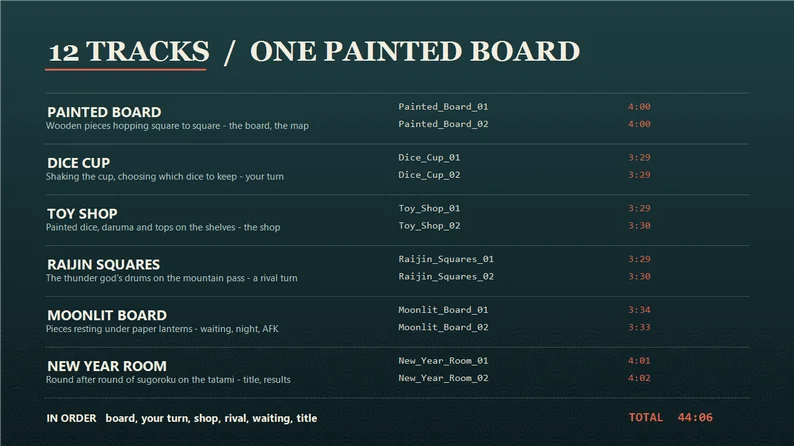
- Painted Board I / II — 4:00 / 4:00 — a koto stepping figure over soft marimba and a kotsuzumi. Both in the set
- Dice Cup I / II — 3:29 / 3:29 — marimba alone over a low bass, single koto notes. I in D minor, II in D major (next to the set)
- Toy Shop I / II — 3:29 / 3:30 — a shamisen plucking a friendly figure over marimba and wooden clappers. I in G major, II in the set
- Raijin Squares I / II — 3:29 / 3:30 — the figure doubled by a shamisen over a deep taiko pulse. I in the set (A major with a borrowed F), II in D-sharp minor
- Moonlit Board I / II — 3:34 / 3:33 — slow koto phrases over marimba and a drone, a shakuhachi. I in G minor, II in D minor
- New Year Room I / II — 4:01 / 4:02 — a koto over a soft hand drum, a shinobue and small bells. Both centred on D
Cues: Roll (0.8s — two soft rising notes, the quietest cue, for every throw) · Good Roll (2.0s — notes that climb) · Bad Roll (1.5s — notes that fall, gently, not a scolding sound) · Agari (3.5s — a phrase that rings out, for the finish square or a floor cleared) — two takes of each, levelled by how often they play. An honest note: the cues are soft plucked and struck notes, without the bell or low wooden knock the briefs asked for. Roll is a small musical sign, not a dice-rattle effect.
44 minutes 6 seconds. The shortest track is 3:29; the board and the title room run four minutes. Nothing builds to a single climax. Board, shop and rival are matched at -14.0 LUFS; the thinking track sits at -14.8, the waiting track at -14.5. Full and Seamless Loop versions of every track, 64 files.
Best for
- Dice roguelikes and dice-building games, for games like Dicey Dungeons and Dice & Fold
- Luck and slot-style roguelites with a shop between rounds, for games like Luck be a Landlord
- Digital board games and roll-and-move party games with turns, a shop and a final stretch, for games in the style of Mario Party boards
- Local multiplayer and hot-seat games where players wait for each other’s turns
Game names are style references only. WAFU Sound Works is not affiliated with them.
Code in the README (Godot 4 and Unity)
What dice and board game players keep reporting: short loops in long runs, grating repeated dice sounds, music too busy to think over, and a song that restarts at every shop visit.
- Board, shop, rival — nothing restarts — the four set tracks run together and only their volumes move; open_shop and close_shop remember where you were.
- A thinking track — on your own turn, ten seconds without a press slips into Dice Cup over 8 seconds; any press brings the board back in 4.
- Waiting and long runs — other players’ turns get Moonlit Board at -6 dB; after two loops the music rests at -18 dB for 20–40 seconds; a minigame mutes the board without stopping it.
- Hundreds of throws — one Roll cue per throw however many dice, never closer than 0.25 s, alternating takes, ±3% pitch; good and bad roll cues only when the throw is remarkable; silent on fast-forward.
What's in the download
- WAFU_Vol47_WAV.zip (904 MB) — WAV/Full, WAV/Loop and WAV/Stingers
- WAFU_Vol47_OGG.zip (111 MB) — the same in OGG, for Godot, Unity, GameMaker, RPG Maker and web builds
Every loop has its tail crossfaded into its own opening, so it wraps with no gap. Both ZIPs include the README and LICENSE.
License: royalty-free for unlimited commercial and non-commercial projects, no credit required, no Content ID claims (we do not register these tracks with any fingerprinting service). No reselling the audio itself, no streaming-platform uploads, no AI training. Full terms in LICENSE.txt.
Buying more than one? Complete Bundle — all 46 packs for $234.99 ($5.11 each) · WAFU Everything — $244.99, all 46 packs plus every future volume.
Made with generative AI (Suno, paid commercial plan), then designed, auditioned, looped, leveled and cue-cut by hand in Japan. If a loop clicks or a file is wrong, message me and I will fix it.
Also available
- The Card Quartet (WAFU Vol.38–41) — the card-game series: a deckbuilder run, card battles, a quiet solitaire and an occult duel, four packs for $24.99. Card and dice roguelikes share a lot of players.
- Japanese Card Game Music Pack — The Hanafuda Table (WAFU Vol.38) — the night-time gambling den to this pack’s daytime board.
- Japanese Puzzle Music Pack — Turn by Turn (WAFU Vol.15) — a board you solve alone, for long thinking.
- Japanese City Builder Music Pack — Stone by Stone (WAFU Vol.46) — one castle town raised from nothing, for city builders and colony sims.
Every WAFU pack is on the store page — seventeen complete volumes are free, starting with the Free Sampler.
🎼 Need a track no pack has? I write custom music to order — one track from $79. How it works. Follow this page to hear when the next volume is added.
Cover art: Utagawa Sadahide, “Tokaido gojusan-tsugi meisho ichiran sugoroku” (a picture-sugoroku board of the Tokaido road), 1862. Public domain, from the collection of the National Diet Library, Japan (via Wikimedia Commons).
 GetAssetPack