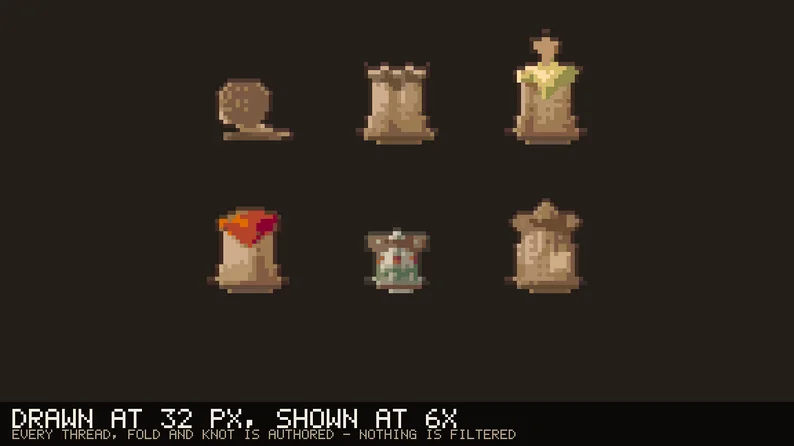
Sackcloth is a 32x32 pixel art asset pack of sacks, bags and burlap cloth: 120 indexed PNG-8 files covering 28 open sacks, 28 filled sacks, 14 drawstring sacks, 14 embroidered pouches, 14 ties and knots, 14 cloth swatches and bolts, and 8 seamless burlap textures.
28 empty open sacks - fourteen narrow, fourteen wide, every one a different shape
Show full description...
28 sacks filled and heaped - wheat, flour, barley, coffee, chilli, turmeric, cinnamon, peas, lentils, maize and more, 9 distinct contents
14 large drawstring sacks - patched, stained, bowed, and four in bleached linen
14 small embroidered pouches - sprigs, hearts, stripes, checks, a wreath
14 ties and knots drawn flat, plus three corded sacks - bows, reef, figure-of-eight, lashings, a coil, a frayed end
14 oval cloth swatches and rolled bolts - twelve weaves, one shape
8 seamless 32x32 burlap textures - plain, hopsack, twill, striped, bleached, worn
120 files. 32x32 px. Indexed PNG-8. One 87-colour palette in 6 banks of sixteen.
The cloth is woven, not noised
Every other way of texturing burlap at this size is a dither, and a dither reads as static. Hessian is a plain weave - one thread over one - which at 32 px is a two-pixel checker of warp over weft with a crossing shadow at the corners. So that is what is drawn: a real weave, with each thread carrying its own thickness, because the lumps in hand-spun jute are the most recognisable thing about it.
And the weave is drawn in the cloth's coordinates, not the screen's. The warp count round a sack does not change when you gather it into a neck, so the same threads are squeezed into a quarter of the width - the weave visibly crowds at the tie and opens out across the belly. Nothing draws that; it falls out of using arc length. It is also why the texture sits ON the sacks instead of floating in front of them.
One palette, 87 colours, 6 banks of sixteen
Every PNG carries the whole table and every sprite draws from exactly one bank, so a sprite structurally cannot use a colour outside it. Every entry is a legal BGR555 value, so the pack drops into a 16-bit target unchanged. Recolouring the whole pack is a palette swap; recolouring one bank is a swap of sixteen entries - turn every jute sack into canvas, or every spice sack into a different spice, without touching a pixel.
Every sack is a different sack
The sixty shape-led sprites are checked pairwise against each other: no two may share a silhouette, and the closest pair in the finished pack differs by nearly three percent of its area. That is the "only twenty percent of it is usable" review answered with a measurement instead of a promise. Six rows in the catalogue were re-proportioned because the check failed them.
It drops in without alignment work
- Every standing sprite has its feet on the same line - y = 28 in its own 32 px cell - so two of them placed at one map coordinate stand on the same spot. The number is in the manifest as each sprite's anchor.
- The knots and ties are drawn flat, with no contact shadow, because they are meant to be laid over your own crates and barrels.
- Per-family sheets and one whole-pack sheet, all fourteen columns wide, with Aseprite-format JSON any importer can cut.
- Individual PNGs are indexed PNG-8 with one transparent index. meta/manifest.json lists every file with its size, bank, anchor, family, contents and tags. INDEX.md is the same list for a human.
- Palettes ship as .gpl (Aseprite, GIMP, Krita), as a .hex list, and as a strip PNG laid out as the banks.
What it is for
Granaries, mills, market stalls, cellars, docks, merchant carts, caravan camps, alchemists' shelves, inn storerooms - anywhere a top-down or three-quarter game needs something to have been stored in. The spice and pulse banks give a market its colour without a single sprite leaving the palette.
Licence
Use and modify in unlimited personal and commercial projects, including games you sell. No attribution required. You may not resell the assets themselves as an asset pack, and you may not train a generative model on them.
Every pixel was generated by the author's own tool from a description of what the thing is. Nothing here is traced, ripped, photographed or model-generated. The source that made it ships in source.
Questions
What size are the sprites?
Every sprite is 32x32 pixels, drawn at that size rather than scaled down from larger art. The cloth tiles are 32x32 and seamless on both axes.
Can I recolour it?
Yes, and it is the cheapest thing you can do to this pack. Every file is indexed PNG-8 carrying a 87-colour table laid out as 6 banks of sixteen. Swap one bank's sixteen entries and every sprite that draws from it changes together.
Does it work in Godot or Unity?
Yes. Godot 4: drop a sheet in as an AtlasTexture or a TileSet on a 32x32 grid, filtering Nearest. Unity: the sheet JSON is Aseprite format, so any importer that reads it will cut the rects - set Filter Mode to Point and Compression to None. Anything else can use the individual PNGs and meta/manifest.json.
Are the burlap textures really seamless?
Yes, and it is measured rather than eyeballed. The check compares the wrap-around join against the average of all thirty-one interior pixel pairs, on the finished INDEX arrays rather than on colours - because two adjacent indices holding similar colours pass a look and fail a palette swap.
Is it animated?
No. Everything here is a static prop. The knots and ties are drawn flat with no contact shadow so they can be laid over your own objects.
 GetAssetPack