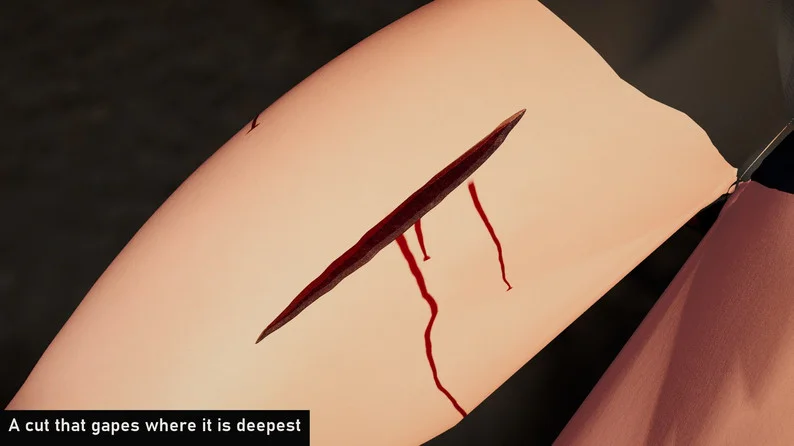
Shoot, cut or smash a character and look into the wound: skin, yellow fat, white fascia, red muscle with its fibres and the bone at the bottom, with blood pooling in the cavity. Carved as real depth into the character's own skin, on any mesh, static or animated, without touching its materials. Unity 6 URP.
Show full description...
Through skin, fat, muscle and bone
Bone depth is worked out per vertex from a table measured on a real skeleton inside a real body. Shins and skulls show bone a few millimetres in, thighs never do. Blood runs down the skin following gravity.
Bullets tear the clothes
A frayed hole for a bullet, a slit for a cut, a wide ragged one for a crater. Loose threads, soot round the hole and blood soaking into the cloth.
Real pieces torn out
Craters tear the skin and the flesh under it out of the body. The pieces fly off trailing drops and land as rigid bodies.
Blunt blows bruise and dent
A red flush that goes dark purple and then dull plum over the seconds after, and the skin pushed in where the blow landed.
Rot from fresh to bare bones
One value from 0 to 1: pale, green, marbled, dark, sloughing, skeletonised. Late rot shrinks the skin onto the bones like dried leather and tears it open. A CC0 135-bone skeleton fits into any humanoid with one click.
Hordes: 1000 rotting zombies (new in 1.2)
One button, Use Crowd Settings, sets a body up for a horde. Wounds and rot are drawn on the character's own renderer, so each body is skinned once and your LOD Group takes them down the levels with it. Every body's wounds sit in one buffer the SRP Batcher draws from, and wounds and rot are drawn flat where a pixel is too coarse to show their depth. Up close nothing changes.
Measured on 1000 walking bodies of 12 600 vertices with LODs, 8 wounds and rot on every one, 1080p, RTX 5060:
- No Flesh: 6.3 ms a frame
- Rot 0.3: 8.2 ms (122 FPS)
- Rot 0.6, skin slipping: 9.0 ms (111 FPS)
New in 1.2.1: the Flesh Horde Demo scene sends 1000 zombies at the camera, each rotting its own way, shot at as they come, with the frame rate on screen and a panel to change the count, the rot speed, the crowd settings and, new in 1.2.3, the wounds each body starts with (0 to 16), so you can load your own card the way the numbers above were measured. Each wound on 1000 bodies costs about 0.1 ms of GPU time. The horde walks with Flesh Shamble, a zombie walk made for the package as a Humanoid clip, so it plays on your own characters too. The clip above is filmed live from that scene: about 105 FPS on average.
The same 1000 bodies took 42 ms a frame with the crowd settings of 1.1. The normal settings draw exactly as before, pixel for pixel.
A body with no wounds and no rot costs nothing. Up to 16 wounds per body.
Easy
- Add Flesh To Selected: one button sets up a character.
- Try It: press Play and click your own character to wound it, no code.
- flesh.Add(hit.point, FleshWoundKind.Bullet) and flesh.Rot = 0.7f. That is the whole API you need.
- A setup window checks and fixes the URP settings.
- A guide for AI coding agents (Claude Code, Codex, Cursor, Copilot).
- Demo scenes: the full feature panel, a rot lineup from fresh to bare bones, and a basement with a first-person bat.
Requirements
Unity 6 with the Universal Render Pipeline, Opaque Texture on (one click in the setup window).
What you get
RNG Flesh 1.2.3 as a .unitypackage and the license file. Updates appear here as new downloads.
License: any number of your own projects, commercial or not; ship it inside built games. No reselling or sharing the source. One license covers one person or a team of up to 5. The demo body and skeleton come from the Blender Human Base Meshes (CC0); the demo sounds were generated with ElevenLabs.
 GetAssetPack