Six townsfolk. Twelve things that happen to them. Ten different ways each of them reacts.
720 lines of original NPC dialogue for a fantasy town, written one at a time by hand rather than assembled from a template — which is why the guard and the temple devout do not sound like the same person wearing different hats.
Drop it in and your crowd stops repeating itself.
Show full description...
Six speakers — Town Guard, Stall Merchant, Street Kid, Records Clerk, Tavern Reveller, Temple Devout.
Twelve situations — greeting, idle ambient, farewell, low reputation, high reputation, combat start, taking damage, fleeing, caught stealing, rumour, night, and refusing you something.
Ten lines in every one of the seventy-two cells. No thin cells, because thin cells are exactly where a bark system audibly fails.
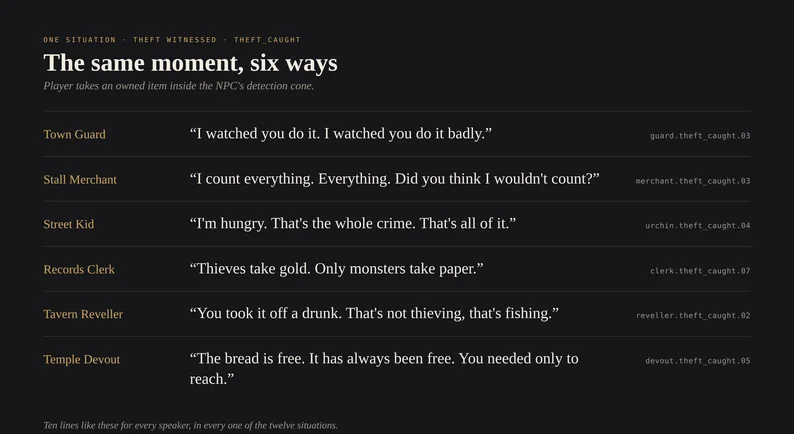
The same moment, six ways — here is theft_caught:
Town Guard: "I watched you do it. I watched you do it badly." Stall Merchant: "I count everything. Everything. Did you think I wouldn't count?" Street Kid: "I'm hungry. That's the whole crime. That's all of it." Records Clerk: "Thieves take gold. Only monsters take paper." Tavern Reveller: "You took it off a drunk. That's not thieving, that's fishing." Temple Devout: "The bread is free. It has always been free. You needed only to reach."
Sixty rumours that are actually quest hooks
Each rumor line is a complete hook stated as gossip — something is wrong, someone noticed, nobody followed it up. None of them names a villain or an outcome, so they attach to whatever your game is about. They also cross-reference: the guard and the clerk each mention the sealed well and disagree about it; four different speakers notice money behaving strangely. Play two or three from different people and a player starts building a theory on their own.
What you get
- barks.json — all 720 lines with speaker, situation, token and word-count metadata, plus the speaker and situation tables. Every situation carries a description of the game event it belongs to, so you can wire it up without guessing.
- barks.csv — the same lines, flat, UTF-8, RFC 4180 quoting. Opens in Unity, Godot, Excel, Sheets, Twine, anything.
- barks.schema.json — JSON Schema (2020-12). Point your build at it.
- bark_picker.js and bark_picker.py — working pickers, zero dependencies, MIT licensed so you can paste them into a commercial project without thinking about it.
- test_bark_picker.mjs and test_bark_picker.py — the 41 tests the pack shipped against.
- validate.py — run it after you add your own lines. Catches duplicates, bad tokens, typos like {palyer}, stale metadata and thin cells.
- README.md — quick starts for JavaScript, Python, Unity, Godot, Twine and spreadsheets.
The picker does the thing most bark systems get wrong
Picking at random means the player hears the same line twice in a row about one time in ten, and they notice immediately. Both pickers use a shuffle bag instead: all ten lines play before any of them repeats, and never back to back across the reshuffle. It is fifteen lines of code and it is the whole difference between a crowd that feels alive and one that feels cheap.
Five substitution tokens — {player}, {place}, {faction}, {item}, {coin} — appear in 45 of the lines, each with a declared fallback so a missing value never leaves a hole in a sentence. The other 675 lines need nothing from you.
Licence
Ship the lines in any game or interactive work, commercial or not, on any platform, no attribution, no revenue cap. Edit them, cut them, translate them, record voice lines from them. The one thing you can't do is resell the lines as text. Full terms are in the download.
Every line is original writing produced for this pack. Nothing here is drawn from any existing game, book, film or setting — there is no third-party rights holder anywhere in it.
Try before you buy — the free sample below has 60 of the lines in the same format, with the real pickers, so you can run the code and judge the writing before paying for anything.
 GetAssetPack