GetAssetPack

Leibniz Corrects an Old Idea
Leibniz Corrects an Old Idea
Price
Free
Type
Icons
Creator
AdamStanislav
License
CC0
Dimensions
2D

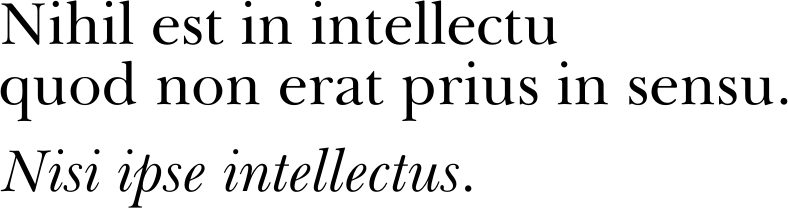
This phrase is in Latin, but the idea comes from Greek philosophy, including that of Aristotle. <i>Nihil est in intellectu quod non erat prius in sensu</i> is one of the Latin expressions of the idea. Usually translated to English as if the words in it had the same meaning now as they did long ago, i.e., <i>Nothing is in the intellect that was not first in the senses.</i> Sorry, I have to disagree with that translation.<br /> But before I get into that, Thomas Aquinas used the word <i>sit</i> rather than <i>erat</i> making it sound more like <i>...that not be first in...</i> Another variation uses <i>fuit</i> for <i>erat</i> which is essentially <i>...that had not been in...</i> Since it is a translation of a Greek idea, all of those variations are reasonable. I am using the one I am using because that was how I remember it from way back in my first year of Psychology studies half a century ago.<br /> Now, as to my objection to the modern translation, the medieval Latin <i>intellectus</i> has a much wider meaning than the modern word <i>intellect</i>. In this context, I prefer to translate it as <i>mind</i>.<br /> My second objection is to the translation of <i>in sensu</i> as <i>in the senses</i>. <i>Sensu</i> is the ablative singular of <i>sensus,</i> from which our modern word of <i>sense(s)</i> comes from. But even then they would have used <i>sensibus,</i> the ablative plural of <i>sensus</i> if they meant the old idea of the five senses. But they did not, they used the singular, so they meant a much wider meaning of the word <i>sensus,</i> which includes <i>perception, sensation,</i> even <i>notion</i>.<br /> So I prefer to express it in English as <i>Nothing is in the mind that was not first in the perception</i>. The idea the ancient philosophers were expressing was that we are what Locke called a <i>tabula rasa</i> (clean slate), that we are born with nothing in the mind and we only became the person we are by perceiving/sensing/experiencing things outside…

Available on

Search by image

Upload a reference to find previews with similar colors, contrast, and detail.

Leibniz Corrects an Old Idea

Leibniz Corrects an Old Idea
AdamStanislav · OpenClipArtFree
2D
Icons
CC0 · Public domain dedication
  • ✓ Commercial use, edits and redistribution
  • ✓ Attribution is optional
  • i Trademark and privacy rights still apply
Show full terms

This phrase is in Latin, but the idea comes from Greek philosophy, including that of Aristotle. <i>Nihil est in intellectu quod non erat prius in sensu</i> is one of the Latin expressions of the idea. Usually translated to English as if the words in it had the same meaning now as they did long ago, i.e., <i>Nothing is in the intellect that was not first in the senses.</i> Sorry, I have to disagree with that translation.<br /> But before I get into that, Thomas Aquinas used the word <i>sit</i> rather than <i>erat</i> making it sound more like <i>...that not be first in...</i> Another variation uses <i>fuit</i> for <i>erat</i> which is essentially <i>...that had not been in...</i> Since it is a translation of a Greek idea, all of those variations are reasonable. I am using the one I am using because that was how I remember it from way back in my first year of Psychology studies half a century ago.<br /> Now, as to my objection to the modern translation, the medieval Latin <i>intellectus</i> has a much wider meaning than the modern word <i>intellect</i>. In this context, I prefer to translate it as <i>mind</i>.<br /> My second objection is to the translation of <i>in sensu</i> as <i>in the senses</i>. <i>Sensu</i> is the ablative singular of <i>sensus,</i> from which our modern word of <i>sense(s)</i> comes from. But even then they would have used <i>sensibus,</i> the ablative plural of <i>sensus</i> if they meant the old idea of the five senses. But they did not, they used the singular, so they meant a much wider meaning of the word <i>sensus,</i> which includes <i>perception, sensation,</i> even <i>notion</i>.<br /> So I prefer to express it in English as <i>Nothing is in the mind that was not first in the perception</i>. The idea the ancient philosophers were expressing was that we are what Locke called a <i>tabula rasa</i> (clean slate), that we are born with nothing in the mind and we only became the person we are by perceiving/sensing/experiencing things outside of ourselves. They actually believed that with proper conditioning of newborns they could prevent them from committing crimes and such.<br /> Enter Leibniz, the German genius mathematician, logician, and philosopher. He corrected their error by adding the words <i>nisi ipse intellectus,</i> meaning <i>except for the mind.</i> He observed that the (human) mind can figure out it exists without ever seeing, touching, smelling, tasting, etc, itself.<br /> Obviously, none of them knew what we know no

View original listing