GetAssetPack

Relief Image of Hades at The Mosul Museum, Iraq
Relief Image of Hades at The Mosul Museum, Iraq
Type
3D Models
Dimensions
3D

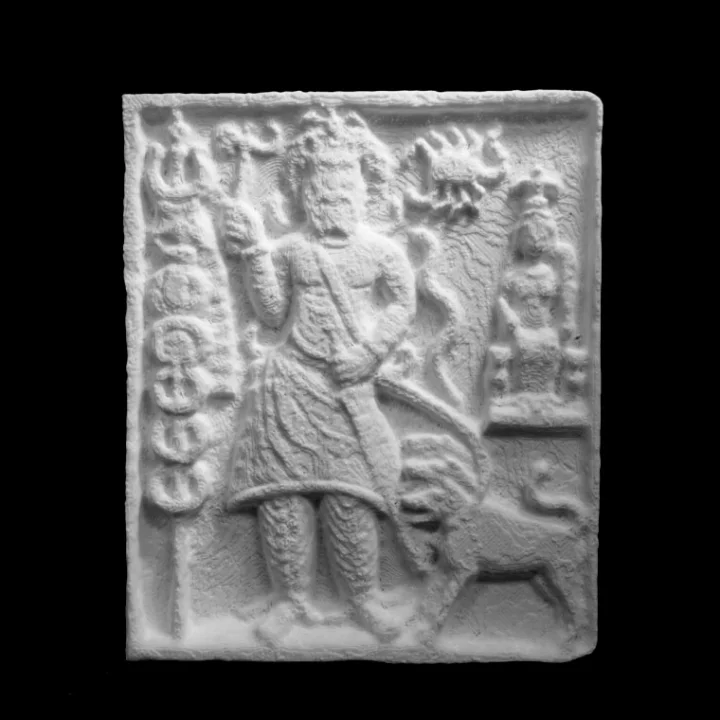
This relief work was found encased in the wall of a certain room in the First Temple. From this First Temple, a variety of religious items and effigies were uncovered. The fact that the bodies of the effigies were unearthed from one room and the heads from other is a good indication of the complete plunder and devastation that the armies of Shapur I wrought when they invaded Hatra. This particular relief work, however, seems to have escaped damage simply from the fact that it was encased in the wall. With this relief as unearthed an altar bearing the name of Kanzayw, a man who dedicated the deified image of himself to the First Temple (MM. 34) and is also the donor of this altar. This relief work without any inscription without any inscription has an important meaning in its design and portrayal, and is a great artistic achievement. In the lower right corner of the slate, you will find three dogs with snakes for tails. Having a common body, the head of the first dog is in high relief; that of the second one is in low relief; and that of the final one in line carving. Likewise, although the legs in the foreground are in high relief, those in the background are represented by carved lines. The body, which is common to all three dogs, is painted black, and so is the head of the first (nearest to the viewer) dog. The head of the second dog, on the other hand, is painted red, while that of the last dog is left unpainted. These three dogs represent, as might be easily inferred, the ferocious Cerberus - guardian dog of Hell in Greek Mythology. It is presumed that the man standing in the centre of this relief and holding the leash represents the sinister king of Hell, master of Cerberus. The man in the centre faces front. He has a hideous look with his abundant hair dishevelled and his forehead tied with a thin string. On each side of his head grows a horn indicating his divinity, while in the front part of his head, an eagle with spread wings dominates. The hair, mustache…

Available on

Search by image

Upload a reference to find previews with similar colors, contrast, and detail.

Relief Image of Hades at The Mosul Museum, Iraq

Relief Image of Hades at The Mosul Museum, Iraq
MyMiniFactory
3D Models
License not indexed
  • i Check the terms on the original listing.
Show full terms

This relief work was found encased in the wall of a certain room in the First Temple. From this First Temple, a variety of religious items and effigies were uncovered. The fact that the bodies of the effigies were unearthed from one room and the heads from other is a good indication of the complete plunder and devastation that the armies of Shapur I wrought when they invaded Hatra. This particular relief work, however, seems to have escaped damage simply from the fact that it was encased in the wall. With this relief as unearthed an altar bearing the name of Kanzayw, a man who dedicated the deified image of himself to the First Temple (MM. 34) and is also the donor of this altar. This relief work without any inscription without any inscription has an important meaning in its design and portrayal, and is a great artistic achievement. In the lower right corner of the slate, you will find three dogs with snakes for tails. Having a common body, the head of the first dog is in high relief; that of the second one is in low relief; and that of the final one in line carving. Likewise, although the legs in the foreground are in high relief, those in the background are represented by carved lines. The body, which is common to all three dogs, is painted black, and so is the head of the first (nearest to the viewer) dog. The head of the second dog, on the other hand, is painted red, while that of the last dog is left unpainted. These three dogs represent, as might be easily inferred, the ferocious Cerberus - guardian dog of Hell in Greek Mythology. It is presumed that the man standing in the centre of this relief and holding the leash represents the sinister king of Hell, master of Cerberus. The man in the centre faces front. He has a hideous look with his abundant hair dishevelled and his forehead tied with a thin string. On each side of his head grows a horn indicating his divinity, while in the front part of his head, an eagle with spread wings dominates. The hair, mustache and beard are painted vermillon. He wears an under-garment and a coat reaching down to the knees with the left side in front - the regular Parthian attire. The collar and the lower hem of the coat are equipped with a wide leather lining with arabesque patterns. On both sides of the lower hem, bells in vermilion (not in carved lines but just painted) hang as ornaments. In the centre of the under-garment, a series of small round ornaments, probably pearls, runs down to the point of the shoes.

View original listing