GetAssetPack

Saint Margaret at The Petit Palais, Paris
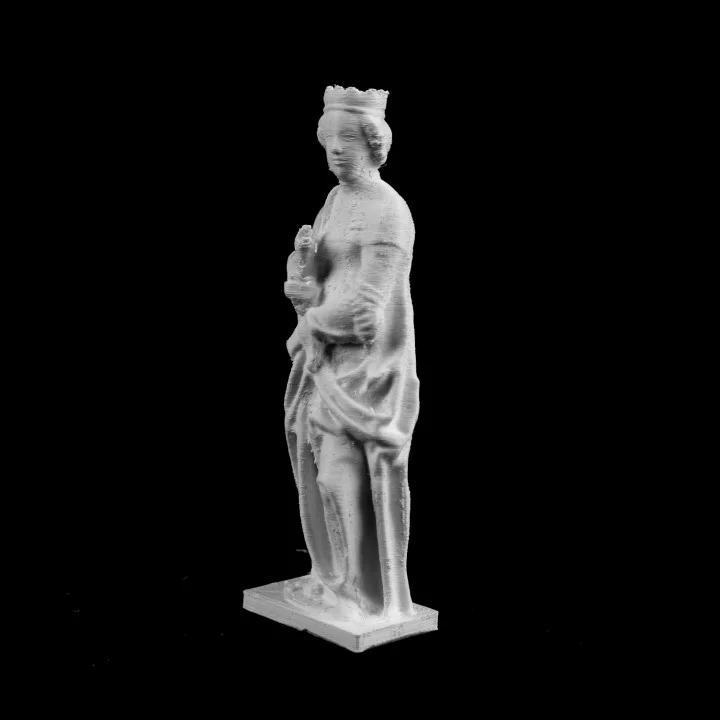
Saint Margaret at The Petit Palais, Paris
Type
3D Models
Dimensions
3D

A 3D model of a sculpture of Saint Margaret, also known as Margaret of Antioch or Saint Marina.

Margaret the Virgin-Martyr, known as Margaret of Antioch (in Pisidia) in the West, and as Saint Marina the Great-Martyr in the East, is celebrated as a saint by the Roman Catholic and Anglican Churches on July 20 and on July 17 in the Orthodox Church. Her historical existence has been questioned. She was declared apocryphal by Pope Gelasius I in 494, but devotion to her revived in the West with the Crusades. She was reputed to have promised very powerful indulgences to those who wrote or read her life, or invoked her intercessions; these no doubt helped the spread of her cultus. According to the version of the story in Golden Legend, she was a native of Antioch, and she was the daughter of a pagan priest named Aedesius. Her mother having died soon after her birth, Margaret was nursed by a pious woman five or six leagues from Antioch. Having embraced Christianity and consecrated her virginity to God, she was disowned by her father, adopted by her nurse and lived in the country keeping sheep with her foster mother (in what is now Turkey). Olybrius, Governor of the Roman Diocese of the East, asked to marry her but with the price of her renunciation of Christianity. Upon her refusal she was cruelly tortured, during which various miraculous incidents occurred. One of these involved being swallowed by Satan in the shape of a dragon, from which she escaped alive when the cross she carried irritated the dragon's innards. The Golden Legend, in an atypical passage of skepticism, describes this last incident as "apocryphal and not to be taken seriously" (trans. Ryan, 1.369). She was put to death in A.D. 304. Saint Margaret, as Saint Marina, with associations to the sea, 'may in turn point to an older goddess tradition', reflecting the pagan divinity Aphrodite. The Eastern Orthodox Church knows Margaret as Saint Marina, and celebrates her feast day on July 17. She has been identified with Saint Pelagia. "Marina" being the Latin equivalent of the Greek name "Pelagia" who…

Available on

Search by image

Upload a reference to find previews with similar colors, contrast, and detail.

Saint Margaret at The Petit Palais, Paris

Saint Margaret at The Petit Palais, Paris
MyMiniFactory
3D Models
License not indexed
  • i Check the terms on the original listing.
Show full terms

Margaret the Virgin-Martyr, known as Margaret of Antioch (in Pisidia) in the West, and as Saint Marina the Great-Martyr in the East, is celebrated as a saint by the Roman Catholic and Anglican Churches on July 20 and on July 17 in the Orthodox Church. Her historical existence has been questioned. She was declared apocryphal by Pope Gelasius I in 494, but devotion to her revived in the West with the Crusades. She was reputed to have promised very powerful indulgences to those who wrote or read her life, or invoked her intercessions; these no doubt helped the spread of her cultus. According to the version of the story in Golden Legend, she was a native of Antioch, and she was the daughter of a pagan priest named Aedesius. Her mother having died soon after her birth, Margaret was nursed by a pious woman five or six leagues from Antioch. Having embraced Christianity and consecrated her virginity to God, she was disowned by her father, adopted by her nurse and lived in the country keeping sheep with her foster mother (in what is now Turkey). Olybrius, Governor of the Roman Diocese of the East, asked to marry her but with the price of her renunciation of Christianity. Upon her refusal she was cruelly tortured, during which various miraculous incidents occurred. One of these involved being swallowed by Satan in the shape of a dragon, from which she escaped alive when the cross she carried irritated the dragon's innards. The Golden Legend, in an atypical passage of skepticism, describes this last incident as "apocryphal and not to be taken seriously" (trans. Ryan, 1.369). She was put to death in A.D. 304. Saint Margaret, as Saint Marina, with associations to the sea, 'may in turn point to an older goddess tradition', reflecting the pagan divinity Aphrodite. The Eastern Orthodox Church knows Margaret as Saint Marina, and celebrates her feast day on July 17. She has been identified with Saint Pelagia. "Marina" being the Latin equivalent of the Greek name "Pelagia" who, according to a legend, was also called Margarita. We possess no historical documents on St. Margaret as distinct from St. Pelagia. The Greek Marina came from Antioch, Pisidia (as opposed to Antioch of Syria), but this distinction was lost in the West. The cultus of Saint Margaret became very widespread in England, where more than 250 churches are dedicated to her, most famously, St. Margaret's, Westminster, the parish church of the British Houses of Parliament in London. Some consider her a patron

A 3D model of a sculpture of Saint Margaret, also known as Margaret of Antioch or Saint Marina.

View original listing