GetAssetPack

St. George at The Kiev Museum of Western and Oriental Art, Ukraine
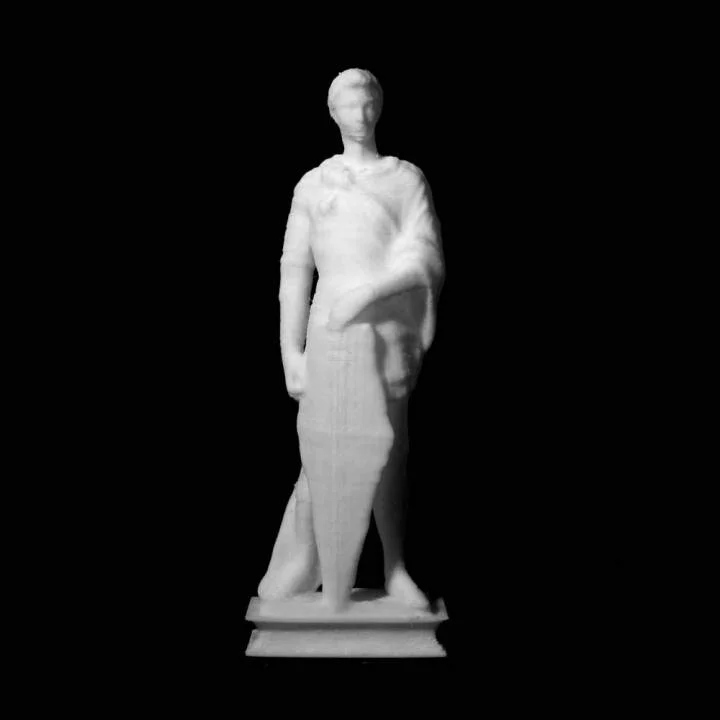
St. George at The Kiev Museum of Western and Oriental Art, Ukraine
Type
3D Models
Dimensions
3D

Donatello carved his statue of St. George for the guild of armorers and swordmakers in Florence. Like the statue of St. Mark, the statue of St. George was destined for the guild’s niche in the building of Orsanmichele. Because the guild was of average size, it could only afford a statue of marble, rather than of bronze. St. George was the patron saint of the armorer’s guild and was known as a military figure, one who was well-known in the Byzantine East, but who was also known by the Crusaders who battled Muslim forces in the Holy Land. A popular tale involving St. George defeating the dragon came to be known through the collection of stories called the Golden Legend (Legenda Aurea) in the late thirteenth century. In Donatello’s work, St. George was carved with a confident posture. He stands tall with his shield in front of him that looks as if could rotate on its small base which touches the ground. This implies, at the very least, a sense of readiness on the part of the saint to quickly confront enemies coming from different directions. To enhance the look of the statue, the guild created special special adornments for it, which might have been put on display on special days of the year, such as the Feast of St. George. These adornments would have included a sword, held in his right hand, a helmet, and a belt. They would have given the statue a bold appearance of metal on marble, and the sword would have projected forward, out of the niche, creating a very visible statement to all walking down the street in front of Orsanmichele. Unlike the statue of St. Mark, the statue of St. George does not stand in contrapposto. Instead, both legs are clearly supporting the saint’s weight, although the front of his left foot is not completely planted on the ground, but instead partially hangs off the front of the base. The purpose of the stance that Donatello gave to St. George was to suggest stability and immobility; he is not supposed to be interpreted as moving, but…

Available on

Search by image

Upload a reference to find previews with similar colors, contrast, and detail.

St. George at The Kiev Museum of Western and Oriental Art, Ukraine

St. George at The Kiev Museum of Western and Oriental Art, Ukraine
MyMiniFactory
3D Models
License not indexed
  • i Check the terms on the original listing.
Show full terms

Donatello carved his statue of St. George for the guild of armorers and swordmakers in Florence.  Like the statue of St. Mark, the statue of St. George was destined for the guild’s niche in the building of Orsanmichele.  Because the guild was of average size, it could only afford a statue of marble, rather than of bronze. St. George was the patron saint of the armorer’s guild and was known as a military figure, one who was well-known in the Byzantine East, but who was also known by the Crusaders who battled Muslim forces in the Holy Land.  A popular tale involving St. George defeating the dragon came to be known through the collection of stories called the Golden Legend (Legenda Aurea) in the late thirteenth century. In Donatello’s work, St. George was carved with a confident posture.  He stands tall with his shield in front of him that looks as if could rotate on its small base which touches the ground.  This implies, at the very least, a sense of readiness on the part of the saint to quickly confront enemies coming from different directions.  To enhance the look of the statue, the guild created special special adornments for it, which might have been put on display on special days of the year, such as the Feast of St. George.  These adornments would have included a sword, held in his right hand, a helmet, and a belt.  They would have given the statue a bold appearance of metal on marble, and the sword would have projected forward, out of the niche, creating a very visible statement to all walking down the street in front of Orsanmichele. Unlike the statue of St. Mark, the statue of St. George does not stand in contrapposto.  Instead, both legs are clearly supporting the saint’s weight, although the front of his left foot is not completely planted on the ground, but instead partially hangs off the front of the base.  The purpose of the stance that Donatello gave to St. George was to suggest stability and immobility; he is not supposed to be interpreted as moving, but instead, as stable and unmoveable.  This is a defensive posture. The reason for such a stance has been linked to political events surrounding Florence during the years leading up to the statue’s creation.  Although Florence was a free Republic during this time, it faced threats by other cities who were more powerful than itself.  One of these cities was Milan, which had been led in 1402 by Gian Galeazzo Visconti to the doorstep of Florence.  With the city surrounded and Florence on the ve

View original listing