GetAssetPack

Bust of Gerardus Mercator in Sint-Niklaas, Belgium
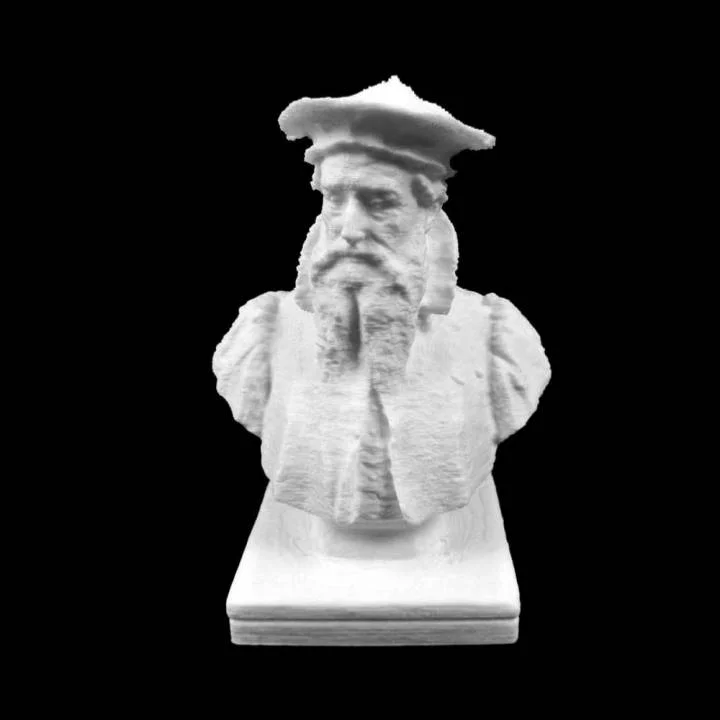
Bust of Gerardus Mercator in Sint-Niklaas, Belgium
Type
3D Models
Dimensions
3D

Gerardus Mercator was born 5 March 1512 in Rupelmonde, County of Flanders (in modern-day Belgium). He died 2 December 1594 in Duisburg, Duchy of Cleves (in modern-day Germany). He is renowned as the cartographer who created a world mapbased on a new projection which represented sailing courses of constant bearing as straight lines—an innovation which to this day enhances the simplicity and safety of navigation. In his own day he was the world's most famous geographer but in addition he had interests in theology, philosophy, history, mathematics and magnetism as well as being an accomplished engraver, calligrapher and maker of globes and scientific instruments. Unlike other great scholars of the age he travelled little and his knowledge of geography came from his library of over one thousand books and maps, from his visitors and from his vast correspondence (in six languages) with other scholars, statesmen, travellers, merchants and seamen. Mercator's early maps were in large formats suitable for wall mounting but in the second half of his life he produced over 100 new regional maps in a smaller format suitable for binding into his Atlas of 1595. This was the first appearance of the word Atlas in a geographical context but Mercator used it as a neologism for a treatise (Cosmologia) on the creation, history and description of the universe, not simply a collection of maps. He chose the word as a commemoration of a King Atlas of Mauretania whom he considered to be the first great geographer. This King Atlas was a son of the Titan Atlas but the two myths very quickly coalesced. A large part of Mercator's income came from the sales of his terrestrial and celestial globes. For sixty years they were considered to be the finest in the world and they were sold in such great numbers that there are many surviving examples. This was a substantial enterprise involving making the spheres, printing the gores, building substantial stands, packing and distributing all over Europe…

Available on

Search by image

Upload a reference to find previews with similar colors, contrast, and detail.

Bust of Gerardus Mercator in Sint-Niklaas, Belgium

Bust of Gerardus Mercator in Sint-Niklaas, Belgium
MyMiniFactory
3D Models
License not indexed
  • i Check the terms on the original listing.
Show full terms

Gerardus Mercator was born 5 March 1512 in Rupelmonde, County of Flanders (in modern-day Belgium). He died 2 December 1594 in Duisburg, Duchy of Cleves (in modern-day Germany). He is renowned as the cartographer who created a world mapbased on a new projection which represented sailing courses of constant bearing as straight lines—an innovation which to this day enhances the simplicity and safety of navigation. In his own day he was the world's most famous geographer but in addition he had interests in theology, philosophy, history, mathematics and magnetism as well as being an accomplished engraver, calligrapher and maker of globes and scientific instruments. Unlike other great scholars of the age he travelled little and his knowledge of geography came from his library of over one thousand books and maps, from his visitors and from his vast correspondence (in six languages) with other scholars, statesmen, travellers, merchants and seamen. Mercator's early maps were in large formats suitable for wall mounting but in the second half of his life he produced over 100 new regional maps in a smaller format suitable for binding into his Atlas of 1595. This was the first appearance of the word Atlas in a geographical context but Mercator used it as a neologism for a treatise (Cosmologia) on the creation, history and description of the universe, not simply a collection of maps. He chose the word as a commemoration of a King Atlas of Mauretania whom he considered to be the first great geographer. This King Atlas was a son of the Titan Atlas but the two myths very quickly coalesced. A large part of Mercator's income came from the sales of his terrestrial and celestial globes. For sixty years they were considered to be the finest in the world and they were sold in such great numbers that there are many surviving examples. This was a substantial enterprise involving making the spheres, printing the gores, building substantial stands, packing and distributing all over Europe. He was also renowned for his scientific instruments, particularly his astrolabes and the sets of "rings" used to study the geometry of astronomy and astrology. Mercator wrote on geography, philosophy, chronology and theology. All of the wall maps were engraved with copious text on the region concerned. As an example the famous world map of 1569 is inscribed with over 5000 words in fifteen legends. The 1595 Atlas has about 120 pages of maps and illustrated title pages but a greater number of pag

View original listing