GetAssetPack

The Inner Voice

The Inner Voice
Type
3D Models
Dimensions
3D

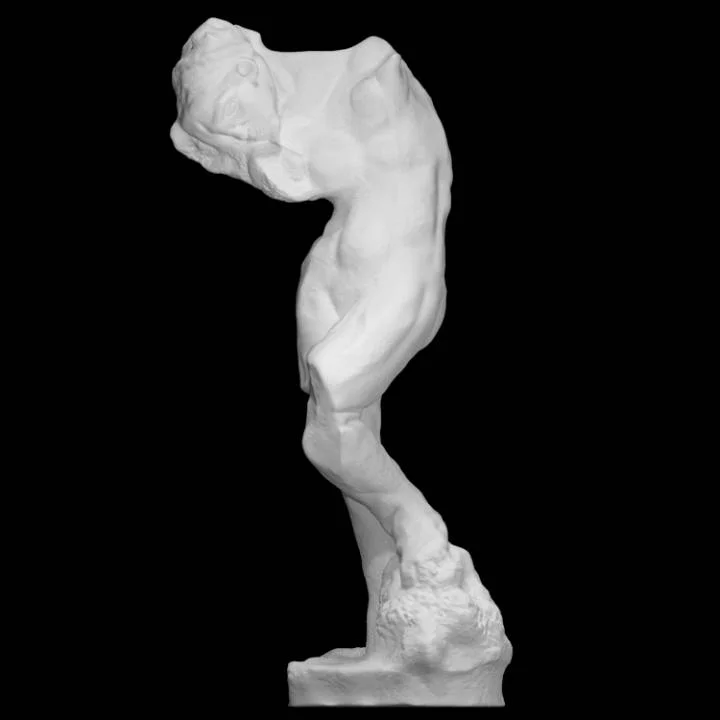
A sculpture model of Rodin’s armless, contemplative figure, also known as Meditation.

Rodin frequently explored the further possibilities that arose from existing projects, revisiting the form, scale, material and, most significantly, the intention of his ideas. 'The Muse' began as small-scale figure on the tympanum (rectangular panel) immediately above the bronze 'Gates of Hell' doors for the new Museum of Decorative Arts, Paris, which Rodin was asked to design in 1880. Rodin later developed the figure as 'The Inner Voice', one of two muses intended for the monument in Paris to the writer Victor Hugo, commissioned in 1886. His composition showed a naked Hugo flanked by two naked muses. The commissioners rejected this proposal as unsuitable for its proposed location in the Panthéon, though they allowed him to continue with the project. After many revisions, Rodin ended up producing this figure. He cut off the arms and removed drapery that covered the knee, which signalled Rodin's increasingly conceptual approach to sculpture. The poet Rainer Maria Rilke, who worked as Rodin's secretary for a time, wrote of it, …'again and again in his figures Rodin returned to this bending inward, to this intense listening to one's own depth… Never was human body assembled to such an extent about its inner self, so bent by its own soul'. Rodin himself said of it: 'My figure represents 'Meditation'. That is why it has neither arms to act nor legs to walk. Haven't you noticed that reflection, when persisted in, suggests so many plausible arguments for opposite directions that it ends in inertia?' Gallery location:In Storage This object is part of "Scan The World". Scan the World is a non-profit initiative introduced by MyMiniFactory, through which we are creating a digital archive of fully 3D printable sculptures, artworks and landmarks from across the globe for the public to access for free. Scan the World is an open source, community effort, if you have interesting items around you and would like to contribute, email stw@myminifactory.com to find out how you can…

Available on

Search by image

Upload a reference to find previews with similar colors, contrast, and detail.

The Inner Voice

The Inner Voice
MyMiniFactory
3D Models
License not indexed
  • i Check the terms on the original listing.
Show full terms

Rodin frequently explored the further possibilities that arose from existing projects, revisiting the form, scale, material and, most significantly, the intention of his ideas. 'The Muse' began as small-scale figure on the tympanum (rectangular panel) immediately above the bronze 'Gates of Hell' doors for the new Museum of Decorative Arts, Paris, which Rodin was asked to design in 1880. Rodin later developed the figure as 'The Inner Voice', one of two muses intended for the monument in Paris to the writer Victor Hugo, commissioned in 1886. His composition showed a naked Hugo flanked by two naked muses. The commissioners rejected this proposal as unsuitable for its proposed location in the Panthéon, though they allowed him to continue with the project. After many revisions, Rodin ended up producing this figure. He cut off the arms and removed drapery that covered the knee, which signalled Rodin's increasingly conceptual approach to sculpture. The poet Rainer Maria Rilke, who worked as Rodin's secretary for a time, wrote of it, …'again and again in his figures Rodin returned to this bending inward, to this intense listening to one's own depth… Never was human body assembled to such an extent about its inner self, so bent by its own soul'. Rodin himself said of it: 'My figure represents 'Meditation'. That is why it has neither arms to act nor legs to walk. Haven't you noticed that reflection, when persisted in, suggests so many plausible arguments for opposite directions that it ends in inertia?'   Gallery location:In Storage   This object is part of "Scan The World". Scan the World is a non-profit initiative introduced by MyMiniFactory, through which we are creating a digital archive of fully 3D printable sculptures, artworks and landmarks from across the globe for the public to access for free. Scan the World is an open source, community effort, if you have interesting items around you and would like to contribute, email stw@myminifactory.com to find out how you can help.Courtesy of the Victoria and Albert Museum, London | Download free and paid 3D printable STL files

A sculpture model of Rodin’s armless, contemplative figure, also known as Meditation.

View original listing