 GetAssetPack
Wellhead
- Type
- 3D Models
- Dimensions
- 3D
- Setting
- Medieval
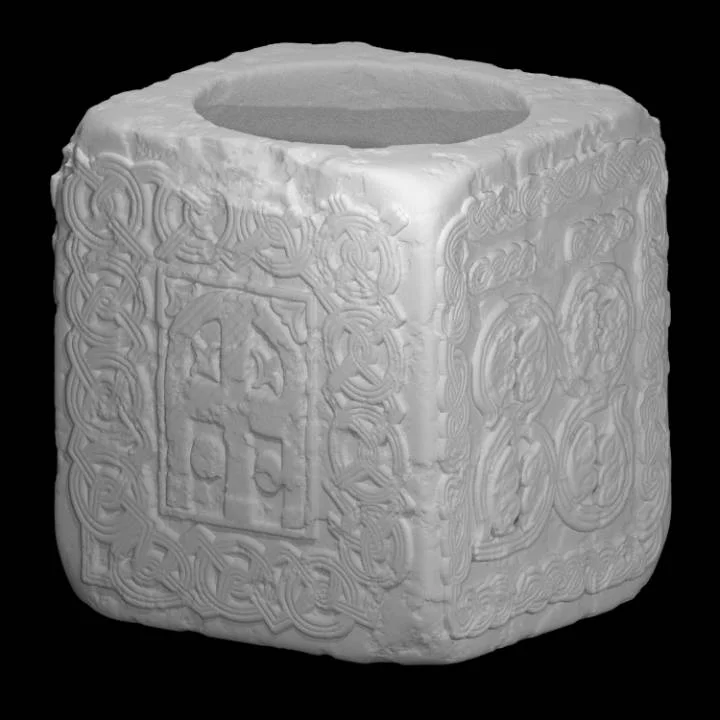
A 3D model of an oblong marble Venetian wellhead with a cylindrical shaft and carved crosses, leaves, flowers, and interlaced patterns.
Wellheads not only protected the mouth of a well, but also provided an opportunity to make public statements of allegiance. The cross under an arch proclaims loyalty to Christ and the Byzantine Empire. Venice at this time was nominally under the control of the Byzantine emperor, although in practice it was independent. Oblong marble well-head with a cylindrical shaft excavated through the block. The four faces are decorated as follows: 1) A cross in an arch surrounded by interlaced ornament 2) Stylised acanthus leaves 3) Interlacing with flowers and rosettes 4) A cross in a rectangle surrounded by interlacing The surface is rubbed and chipped. Face 2 has been pierced near the top. A small fragment of iron is present in face 1 possibly from a stanchion. Although surrounded by water, the supply of fresh water was historically a problem for Venetians. The need to store and supply drinking water in the city gave rise to a vast number of wells, possibly exceeding six thousand. These water sources needed protection at the surface to avoid pollution of the supply. Initially the remains of capitals, columns, funerary urns and other archaeological finds served the purpose of well-heads; cisterns were protected by effectively extending the well shaft up-ward and away from the ground, while still allowing access to the water beneath. The various forms which emerged during the development of purpose made Venetian well-heads owe a great deal to the archaeological and particularly the architectural origins of the phenomenon. The earliest surviving purpose made Venetian well-heads date from the seventh century and take the form of a hollow cube. Cylindrical well-heads followed, developing in the late seventh to early eighth centuries. Many of the relief sculptures roughly datable to the ninth century, which have survived in Venice are overwhelmingly dominated by one single decorative pattern: a large cross set beneath an honorific arch, and flanked by stylized leaves. This design…