GetAssetPack

Head of Germanicus

Head of Germanicus
Type
3D Models
Dimensions
3D

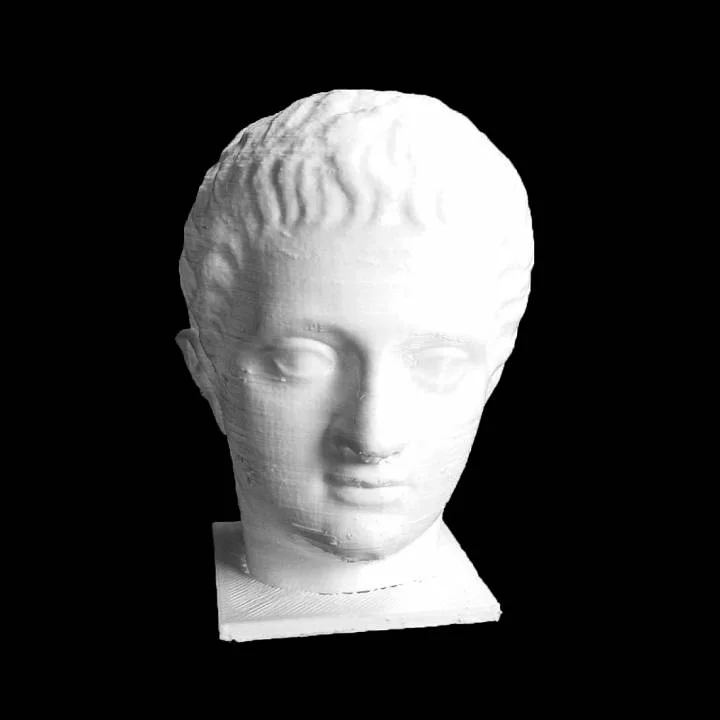
The model for this bust has proven difficult to identify. The hairstyle does not match those of Augustus, whose drooping eyebrows more closely framed the eyes. Nor does the portrait resemble those of any of Augustus’s grandchildren: Caius, Lucius Caesar, and Agrippa Postumus. Clearly executed after Caius’s death in 4 A.D., the face represented can therefore only be that of Germanicus, Livia’s grandson, who married Agrippina the Elder, Augustus’s granddaughter, in 5 A.D. Between his adoption by his uncle Tiberius in 4 A.D. and the death of Augustus ten years later, Germanicus frequently accompanied Augustus on military campaigns. During this period, portraits like this one proliferated. The piece can be dated to this time, between 8 and 10 A.D. (as can the heads in the British Museum 1883 and 1884, the Munich Residenz, and the Louvre Ma 3135). Cast aside by Tiberius after 14 A.D., Germanicus would only begin to be represented again, posthumously, as of 19 A.D. Three hairstyle types are granted to Germanicus; the “Béziers,” “Gabii,” and “Corinto-Stoccarda” types. K. Fittschen has pointed out the similarities between the “Corinto-Stoccarda” capillary features and certain hairstyles worn by Tiberius, Caligula, and Claudius, which would make the “Corinto-Stoccarda” a posthumous type just like the “Gabii” type.1 But this concurrence seems unlikely, since another type, the “Béziers” type, is still evident in 23 A.D. Therefore Fittschen determined that portraits of the “Corinto-Stoccarda” type are not in fact of Germanicus. The Louvre’s new acquisition thus reinforces a type that poses a fundamental problem in the chronology of portraits of Germanicus. In its current state, this male head appears as a mask consisting simply of the face and the front of the neck. The back of the sculpture was cut away on three planes: a vertical or occipital plane, a nearly horizontal or summit plane, and an oblique or right temporal plane. Beneath the Adam’s apple, the neck has been broken…

Available on

Search by image

Upload a reference to find previews with similar colors, contrast, and detail.

Head of Germanicus

Head of Germanicus
MyMiniFactory
3D Models
License not indexed
  • i Check the terms on the original listing.
Show full terms

The model for this bust has proven difficult to identify. The hairstyle does not match those of Augustus, whose drooping eyebrows more closely framed the eyes. Nor does the portrait resemble those of any of Augustus’s grandchildren: Caius, Lucius Caesar, and Agrippa Postumus. Clearly executed after Caius’s death in 4 A.D., the face represented can therefore only be that of Germanicus, Livia’s grandson, who married Agrippina the Elder, Augustus’s granddaughter, in 5 A.D. Between his adoption by his uncle Tiberius in 4 A.D. and the death of Augustus ten years later, Germanicus frequently accompanied Augustus on military campaigns. During this period, portraits like this one proliferated. The piece can be dated to this time, between 8 and 10 A.D. (as can the heads in the British Museum 1883 and 1884, the Munich Residenz, and the Louvre Ma 3135). Cast aside by Tiberius after 14 A.D., Germanicus would only begin to be represented again, posthumously, as of 19 A.D. Three hairstyle types are granted to Germanicus; the “Béziers,” “Gabii,” and “Corinto-Stoccarda” types. K. Fittschen has pointed out the similarities between the “Corinto-Stoccarda” capillary features and certain hairstyles worn by Tiberius, Caligula, and Claudius, which would make the “Corinto-Stoccarda” a posthumous type just like the “Gabii” type.1 But this concurrence seems unlikely, since another type, the “Béziers” type, is still evident in 23 A.D. Therefore Fittschen determined that portraits of the “Corinto-Stoccarda” type are not in fact of Germanicus. The Louvre’s new acquisition thus reinforces a type that poses a fundamental problem in the chronology of portraits of Germanicus. In its current state, this male head appears as a mask consisting simply of the face and the front of the neck. The back of the sculpture was cut away on three planes: a vertical or occipital plane, a nearly horizontal or summit plane, and an oblique or right temporal plane. Beneath the Adam’s apple, the neck has been broken along three lines. Traces of polychromy have survived in the hair, particularly in the hollows of the locks on the right side of the head and above the left eye. The polychromy consists of a calcium carbonate mixed with red ochre, typical of mineral pigments. Traces of paint on the eyes were observed during the restoration. Roman-era heads originally constructed out of several pieces are quite an enigma. The hair, lips, eyes, and clothing were most often given a coat of paint to conceal join

View original listing