GetAssetPack

Mercury

Mercury
Type
3D Models
Dimensions
3D
Setting
Fantasy

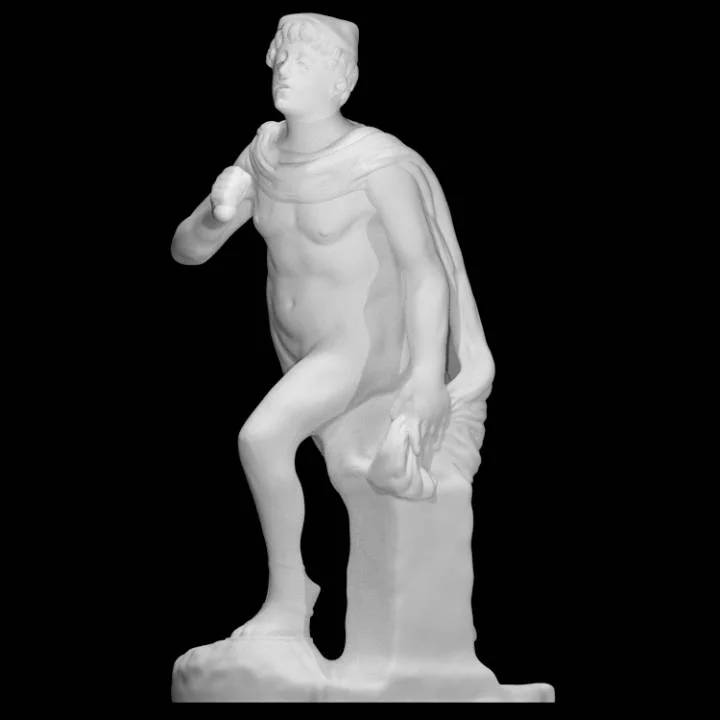
A marble and bronze statuette of Mercury, shown full-length with winged sandals and helmet and a bronze planetary plaque.

The inscription states that this figure was commissioned by the Venetian scholar Marcantonio Michiel and begun on 14 February 1527. His horoscope for 15 June appears on the bronze disc. With Mercury, the god of eloquence, in the ascendant, it was probably intended as a favourable omen for Michieli, who was hoping to gain a seat in the Venetian Senate. This is a statuette of the Roman God Mercury, carved out of marble inlaid with bronze. Mercury is represented in full-length, and is naked save for a cloak clasped at the right shoulder, winged sandals and a winged helmet. Its origin of the is Padia, carved in 1527 by Antonio Minello (1460-1533). The bronze plaque is engraved with a diagram of the planets, showing the motions of Mercury, placed at the top, the relative positions of the planets on 15 June 1527, the date of the completion of the figure. It has been interpreted as a horoscope by Hartner and Pope-Hennessy, with some differences as to the precise time, which Hartner places at 8.04 a.m. and Pope-Hennessy at 11.46 a.m. Pope-Hennessy argues that this shows Mercury in a particularly favourable position as Lord of the Ascendant and of the Midheaven, also in conjunction with the Sun and Jupiter, and that the moment was therefore clearly chosen with great care and must have some special significance for the career of Marcantonio Michiel. He explains this in terms of Michiel's repeated attempts to secure public office, with a particular desire to serve as ambassador, which were dashed in September 1525 as a result of a disgraceful confluct with a relative that caused him to be debarred from public office for a year. By 1527, when the statuette was commissioned, Michiel was free once again to try for office. In that month he married Maffea Soranzo, and began to scheme for election to the senate, in which he was finally successful on 28 September 1527. The peculiarly favourable conjunction of Mercury on 15th June 1527 would therefore have been a good omen for him…

Available on

Search by image

Upload a reference to find previews with similar colors, contrast, and detail.

Mercury

Mercury
MyMiniFactory
3D Models
License not indexed
  • i Check the terms on the original listing.
Show full terms

The inscription states that this figure was commissioned by the Venetian scholar Marcantonio Michiel and begun on 14 February 1527. His horoscope for 15 June appears on the bronze disc. With Mercury, the god of eloquence, in the ascendant, it was probably intended as a favourable omen for Michieli, who was hoping to gain a seat in the Venetian Senate. This is a statuette of the Roman God Mercury, carved out of marble inlaid with bronze. Mercury is represented in full-length, and is naked save for a cloak clasped at the right shoulder, winged sandals and a winged helmet. Its origin of the is Padia, carved in 1527 by Antonio Minello (1460-1533). The bronze plaque is engraved with a diagram of the planets, showing the motions of Mercury, placed at the top, the relative positions of the planets on 15 June 1527, the date of the completion of the figure. It has been interpreted as a horoscope by Hartner and Pope-Hennessy, with some differences as to the precise time, which Hartner places at 8.04 a.m. and Pope-Hennessy at 11.46 a.m. Pope-Hennessy argues that this shows Mercury in a particularly favourable position as Lord of the Ascendant and of the Midheaven, also in conjunction with the Sun and Jupiter, and that the moment was therefore clearly chosen with great care and must have some special significance for the career of Marcantonio Michiel. He explains this in terms of Michiel's repeated attempts to secure public office, with a particular desire to serve as ambassador, which were dashed in September 1525 as a result of a disgraceful confluct with a relative that caused him to be debarred from public office for a year. By 1527, when the statuette was commissioned, Michiel was free once again to try for office. In that month he married Maffea Soranzo, and began to scheme for election to the senate, in which he was finally successful on 28 September 1527. The peculiarly favourable conjunction of Mercury on 15th June 1527 would therefore have been a good omen for him. This interpretation has since been questioned by Fletcher, and more recently by Eade, who has brought into question the astrological status of the plaque. Observing that the earlier astrological calculations were wrong and that on 15 June 1527 Mercury was unfavourably positioned, Eade interprets the plaque not as a horoscope, but as a simple astronomical diagram showing the position of Mercury on 15 June 1527 in relation to other planets. The Mercury appears in the earliest inventory of Michiel'

A marble and bronze statuette of Mercury, shown full-length with winged sandals and helmet and a bronze planetary plaque.

View original listing