 GetAssetPack
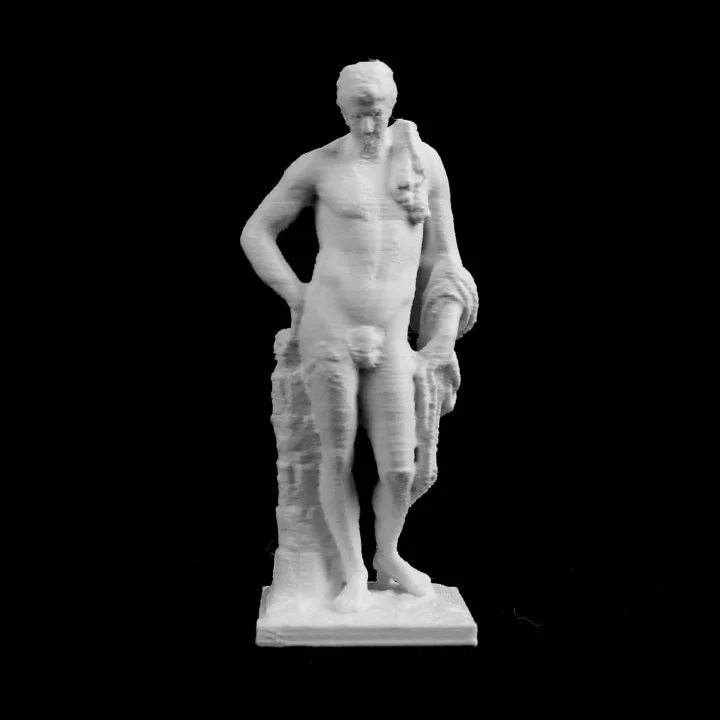
Hermes of the Museo Pio-Clementino in The Palace of Versailles, France
- Type
- 3D Models
- Dimensions
- 3D
The Hermes of the Museo Pio-Clementino, part of the Vatican collections, Rome, was long admired as the Belvedere Antinous, named from its prominent placement in the Cortile del Belvedere. It is now inventory number 907 in the Museo Pio-Clementino. This was a restored cast of the original sculpture done by an unknown artist which is now on permanent display at the Gardens of the Palace of Versailles, France. Its idealized face is not in fact that of Antinous, the Emperor Hadrian's beloved. The cloak known as a chlamys, thrown over the left shoulder and wrapped round the left forearm, and the relaxed contrapposto identify the sculpture as a Hermes, one of a familiar Praxitelean type. Today the sculpture is considered (in the most recent Helbig) to be a Hadrianic copy (early second century CE) of a bronze by Praxiteles or one of his school. At life size the statue shows a nude young man with a chlamys on his shoulder and left forearm. It is a variant of the Andros type; the Andros example has the chlamys and a serpent twined round the tree-support, with the tree and serpent allowing its definite identification as Hermes as psychopompus; it is directly influenced by the Hermes and the Infant Dionysus of Praxiteles. The sculpture was bought for the Farnese Pope Paul III in 1543, when a thousand ducats were paid to "Nicolaus de Palis for a very beautiful marble statue... which His Holiness has sent to be placed in the Belvedere garden". The most likely site for its discovery is in a garden near Castel Sant'Angelo, where the Palis had property. The statue was immediately famous, as the Antinous Admirandus: it was mentioned in all the accounts of the antiquities to be seen in Rome, engraved in all the repertories of classical art, universally admired and copied in bronze and marble for Fontainebleau in the sixteenth century and Versailles in the seventeenth century. A bronze copy by Hubert Le Sueur figured in the collections of Charles I of England before being acquired by…