GetAssetPack

Neptune and Triton

Neptune and Triton
Type
3D Models
Dimensions
3D
Setting
Underwater

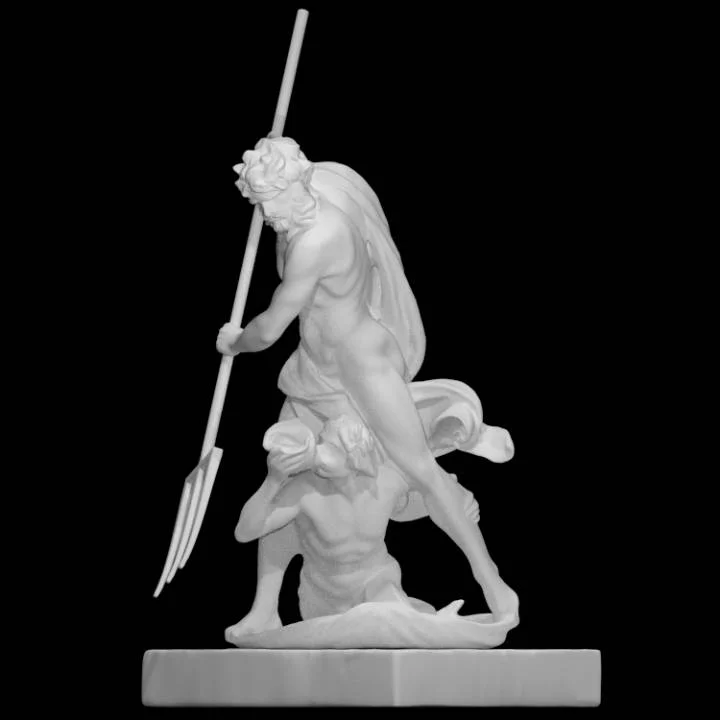
A 3D model of the Baroque sculpture group Neptune and Triton, originally designed as a fountain centerpiece.

The group was commissioned from the leading Italian Baroque sculptor, Gianlorenzo Bernini, by Alessandro Peretti, Cardinal Montalto, for the garden of the Villa Montalto in Rome, and carved within a year in 1622-23. In the seventeenth and eighteenth centuries the group was one of the most celebrated sights in Rome, and a number of engravings show it in its original position, standing at the upper end of the large fish-pond, known as the Peschiera or Peschierone, in the Montalto garden. This impressive group originally formed the centrepiece of a complex system of fountains and cascades. It projected a single jet of water through the conch-shell held by Triton, who was misidentified as 'Glaucus' (the fisherman who, according to mythology, turned into a merman - half man, half fish) in some engravings and references. In classical mythology Neptune ruled over the seas and its inhabitants. His son Triton was a merman. Neptune and Triton are portrayed with great vitality as they command the seas, which we are to be imagined around the base of the group. The composition may be based on Ovid's account of the Flood (Metamorphoses, Book 1, 330-42), in which Triton is ordered by Neptune to blow his conch-shell to summon the waters to retreat. However, it is also often associated with the Quos Ego ('Whom I'), Neptune's unfinished threat to the winds to cease stirring the seas, from Virgil's Aeneid (Book 1, 135). In classical mythology Neptune ruled over the seas and its inhabitants. His son Triton was a merman. Neptune and Triton are portrayed with great vitality as they command the seas, which we are to be imagined around the base of the group. The composition may be based on Ovid's account of the Flood (Metamorphoses, Book 1, 330-42), in which Triton is ordered by Neptune to blow his conch-shell to summon the waters to retreat. However, it is also often associated with the Quos Ego ('Whom I'), Neptune's unfinished threat to the winds to cease stirring the seas, from…

Available on

Search by image

Upload a reference to find previews with similar colors, contrast, and detail.

Neptune and Triton

Neptune and Triton
MyMiniFactory
3D Models
License not indexed
  • i Check the terms on the original listing.
Show full terms

The group was commissioned from the leading Italian Baroque sculptor, Gianlorenzo Bernini, by Alessandro Peretti, Cardinal Montalto, for the garden of the Villa Montalto in Rome, and carved within a year in 1622-23. In the seventeenth and eighteenth centuries the group was one of the most celebrated sights in Rome, and a number of engravings show it in its original position, standing at the upper end of the large fish-pond, known as the Peschiera or Peschierone, in the Montalto garden. This impressive group originally formed the centrepiece of a complex system of fountains and cascades. It projected a single jet of water through the conch-shell held by Triton, who was misidentified as 'Glaucus' (the fisherman who, according to mythology, turned into a merman - half man, half fish) in some engravings and references. In classical mythology Neptune ruled over the seas and its inhabitants. His son Triton was a merman. Neptune and Triton are portrayed with great vitality as they command the seas, which we are to be imagined around the base of the group. The composition may be based on Ovid's account of the Flood (Metamorphoses, Book 1, 330-42), in which Triton is ordered by Neptune to blow his conch-shell to summon the waters to retreat. However, it is also often associated with the Quos Ego ('Whom I'), Neptune's unfinished threat to the winds to cease stirring the seas, from Virgil's Aeneid (Book 1, 135). In classical mythology Neptune ruled over the seas and its inhabitants. His son Triton was a merman. Neptune and Triton are portrayed with great vitality as they command the seas, which we are to be imagined around the base of the group. The composition may be based on Ovid's account of the Flood (Metamorphoses, Book 1, 330-42), in which Triton is ordered by Neptune to blow his conch-shell to summon the waters to retreat. However, it is also often associated with the Quos Ego ('Whom I'), Neptune's unfinished threat to the winds to cease stirring the seas, from Virgil's Aeneid (Book 1, 135). This object is part of "Scan The World". Scan the World is a non-profit initiative introduced by MyMiniFactory, through which we are creating a digital archive of fully 3D printable sculptures, artworks and landmarks from across the globe for the public to access for free. Scan the World is an open source, community effort, if you have interesting items around you and would like to contribute, email stw@myminifactory.com to find out how you can help. Courtesy of the Vi

A 3D model of the Baroque sculpture group Neptune and Triton, originally designed as a fountain centerpiece.

View original listing