GetAssetPack

Grave Stele of Hegeso

Grave Stele of Hegeso
Type
3D Models
Dimensions
3D

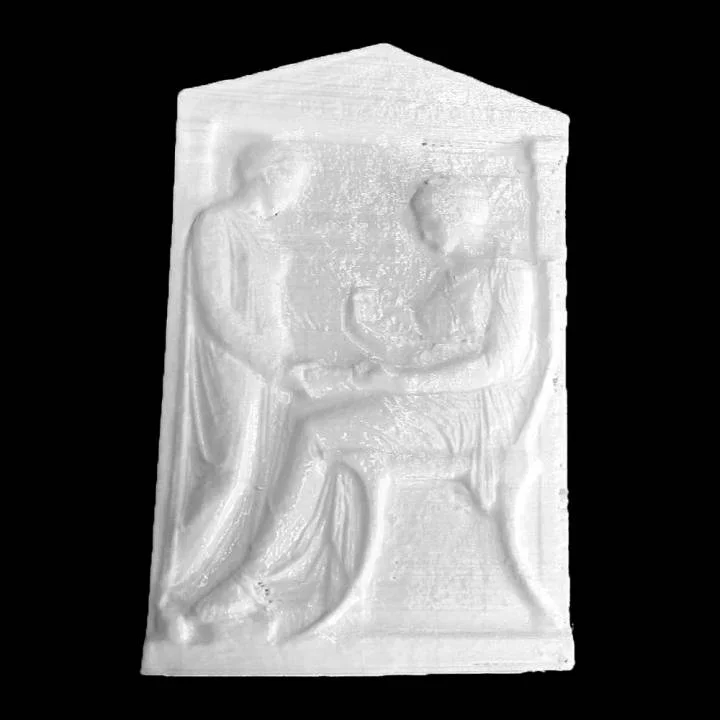
The Grave Stele of Hegeso, most likely sculpted by Callimachus, is renowned as one of the finest Attic grave stelae surviving (mostly intact) today. Dated from ca. 410 - ca. 400 BCE, it is made entirely of Pentelic marble. It stands 1.56m high and .97m wide, in the form of a naiskos, with pilasters and a pediment featuring palmette acroteria. The relief, currently on display at the National Archaeological Museum in Athens was found in 1870 in the Kerameikos in Athens, which now houses a replica of it. The one here is another replica. In its current condition, it is almost complete, but has been restored around its edges. The plinth has mostly broken off and there is slight damage on the head of Hegeso. The main shows a mature Athenian woman (Hegeso) wearing a chiton and himation, seated on a chair with her feet resting on an elaborate footstool. In her left hand, she holds an open pyxis, and in her right she holds a piece of (missing) jewelry that was originally painted, at which she is directing her gaze. Opposite her, on the left, stands a maidservant wearing a tunic and a headdress described as either a snood or sakkos. The maidservant is presenting the pyxis, on the knees of Hegeso. On the epistyle there is an epitaph, stating that the deceased is Hegeso, daughter of Proxenios. In general, stelae can be seen as a retrospective funerary art, that typically articulate a society's ideals of social living through their depiction of a domestic sphere. Compared to other non-civic art of the oikos (home), such as non-funerary red-figure painted pottery, stelae were obviously more fixed/permanent monuments, displayed outdoors for public viewing, and are constructed by a family for a specific person, making them far more expensive and exclusive than pottery. While their medium, context, and style associate stelae with the polis (city), their iconography is of the oikos. This paradox, as well as the prominence of women on gravestones, has led many scholars to focus on an…

Available on

Search by image

Upload a reference to find previews with similar colors, contrast, and detail.

Grave Stele of Hegeso

Grave Stele of Hegeso
MyMiniFactory
3D Models
License not indexed
  • i Check the terms on the original listing.
Show full terms

The Grave Stele of Hegeso, most likely sculpted by Callimachus, is renowned as one of the finest Attic grave stelae surviving (mostly intact) today. Dated from ca. 410 - ca. 400 BCE, it is made entirely of Pentelic marble. It stands 1.56m high and .97m wide, in the form of a naiskos, with pilasters and a pediment featuring palmette acroteria. The relief, currently on display at the National Archaeological Museum in Athens was found in 1870 in the Kerameikos in Athens, which now houses a replica of it. The one  here is another replica.  In its current condition, it is almost complete, but has been restored around its edges. The plinth has mostly broken off and there is slight damage on the head of Hegeso. The main shows a mature Athenian woman (Hegeso) wearing a chiton and himation, seated on a chair with her feet resting on an elaborate footstool. In her left hand, she holds an open pyxis, and in her right she holds a piece of (missing) jewelry that was originally painted, at which she is directing her gaze. Opposite her, on the left, stands a maidservant wearing a tunic and a headdress described as either a snood or sakkos. The maidservant is presenting the pyxis, on the knees of Hegeso. On the epistyle there is an epitaph, stating that the deceased is Hegeso, daughter of Proxenios. In general, stelae can be seen as a retrospective funerary art, that typically articulate a society's ideals of social living through their depiction of a domestic sphere. Compared to other non-civic art of the oikos (home), such as non-funerary red-figure painted pottery, stelae were obviously more fixed/permanent monuments, displayed outdoors for public viewing, and are constructed by a family for a specific person, making them far more expensive and exclusive than pottery. While their medium, context, and style associate stelae with the polis (city), their iconography is of the oikos. This paradox, as well as the prominence of women on gravestones, has led many scholars to focus on an analysis of the virtues designated to different genders on the stelae. While Hegeso's relief may show a purely domestic scene, the virtues it honors may not have been solely for private consumption. Rather than simply celebrating the individual lives of certain women, the presence of stelae similar to that of Hegeso serve to define the female within a recognized social framework. From 450 BCE on, Athenian citizens (men) had a much greater vested interest in displaying his mother's status,

View original listing