GetAssetPack

Hercules Killing the Hydra at The Louvre, Paris
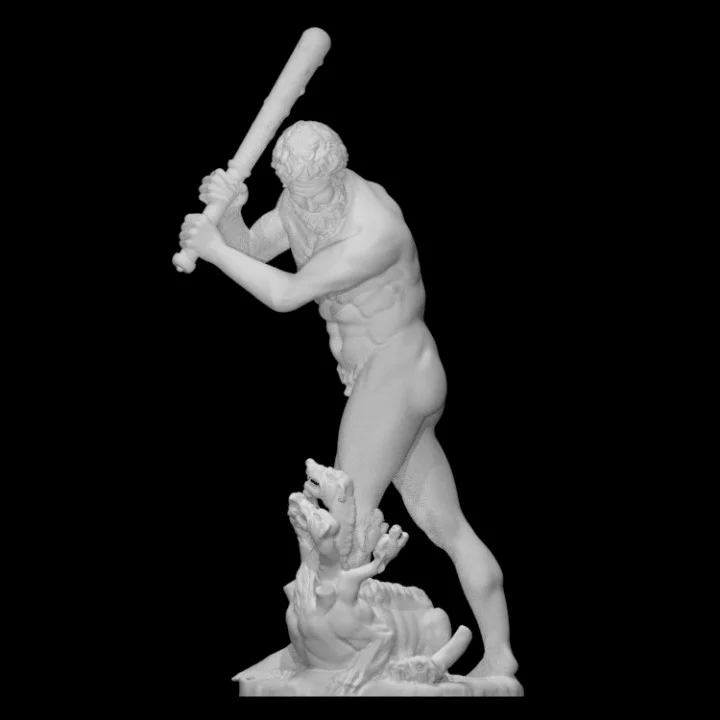
Hercules Killing the Hydra at The Louvre, Paris
Type
3D Models
Dimensions
3D
Setting
Fantasy

A 3D model of Hercules fighting the Lernaean Hydra, the second of his legendary twelve labours.

The twelve labours of Hercules are a series of episodes concerning apenance carried out by Heracles, the greatest of the Greek heroes, whose name was later Romanised as Hercules. They were accomplished over 12 years at the service of King Eurystheus. The episodes were later connected by a continuous narrative. The establishment of a fixed cycle of twelve labours was attributed by the Greeks to an epic poem, now lost, written by Peisander, dated about 600 BC. Driven mad by Hera, Hercules slew his six sons and his wife Megara. After recovering his sanity, Hercules deeply regretted his actions; he was purified by King Thespius, then traveled to Delphi to inquire how he could atone for his actions. Pythia, the Oracle of Delphi, advised him to go to Tiryns and serve his cousin King Eurystheus for twelve years, performing whatever labours Eurystheus might set him; in return, he would be rewarded with immortality. Hercules despaired at this, loathing to serve a man whom he knew to be far inferior to himself, yet fearing to oppose his father Zeus. Eventually, he placed himself at Eurystheus's disposal. Eurystheus ordered Hercules to perform Twelve labours. Hercules accomplished these tasks, but Eurystheus refused to recognize two: the slaying of the Lernaean Hydra, as Hercules' nephew and charioteer Iolaus had helped him; and the cleansing of the Augeas, because Hercules accepted payment for the labour. Eurystheus set two more tasks (fetching the Golden Apples of Hesperides and capturing Cerberus), which Hercules also performed, bringing the total number of tasks to twelve. The second labour was to slay the Lernaean Hydra, which Hera had raised just to slay Hercules. Upon reaching the swamp near Lake Lerna, where the Hydra dwelt, Hercules covered his mouth and nose with a cloth to protect himself from the poisonous fumes. He fired flaming arrows into the Hydra's lair, the spring of Amymone, a deep cave that it only came out of to terrorize neighboring villages.[6] He then…

Available on

Search by image

Upload a reference to find previews with similar colors, contrast, and detail.

Hercules Killing the Hydra at The Louvre, Paris

Hercules Killing the Hydra at The Louvre, Paris
MyMiniFactory
3D Models
License not indexed
  • i Check the terms on the original listing.
Show full terms

The twelve labours of Hercules are a series of episodes concerning apenance carried out by Heracles, the greatest of the Greek heroes, whose name was later Romanised as Hercules. They were accomplished over 12 years at the service of King Eurystheus. The episodes were later connected by a continuous narrative. The establishment of a fixed cycle of twelve labours was attributed by the Greeks to an epic poem, now lost, written by Peisander, dated about 600 BC. Driven mad by Hera, Hercules slew his six sons and his wife Megara. After recovering his sanity, Hercules deeply regretted his actions; he was purified by King Thespius, then traveled to Delphi to inquire how he could atone for his actions. Pythia, the Oracle of Delphi, advised him to go to Tiryns and serve his cousin King Eurystheus for twelve years, performing whatever labours Eurystheus might set him; in return, he would be rewarded with immortality. Hercules despaired at this, loathing to serve a man whom he knew to be far inferior to himself, yet fearing to oppose his father Zeus. Eventually, he placed himself at Eurystheus's disposal.   Eurystheus ordered Hercules to perform Twelve labours. Hercules accomplished these tasks, but Eurystheus refused to recognize two: the slaying of the Lernaean Hydra, as Hercules' nephew and charioteer Iolaus had helped him; and the cleansing of the Augeas, because Hercules accepted payment for the labour. Eurystheus set two more tasks (fetching the Golden Apples of Hesperides and capturing Cerberus), which Hercules also performed, bringing the total number of tasks to twelve. The second labour was to slay the Lernaean Hydra, which Hera had raised just to slay Hercules. Upon reaching the swamp near Lake Lerna, where the Hydra dwelt, Hercules covered his mouth and nose with a cloth to protect himself from the poisonous fumes. He fired flaming arrows into the Hydra's lair, the spring of Amymone, a deep cave that it only came out of to terrorize neighboring villages.[6] He then confronted the Hydra, wielding a harvesting sickle (according to some early vase-paintings), a sword or his famed club. Ruck and Staples (1994: 170) have pointed out that the chthonic creature's reaction was botanical: upon cutting off each of its heads he found that two grew back, an expression of the hopelessness of such a struggle for any but the hero. The weakness of the Hydra was that only one of its heads was immortal. The details of the struggle are explicit in the Bibliotheca (2.5.

A 3D model of Hercules fighting the Lernaean Hydra, the second of his legendary twelve labours.

View original listing