GetAssetPack

Arria and Paetus at The Louvre, Paris
Arria and Paetus at The Louvre, Paris
Type
3D Models
Dimensions
3D

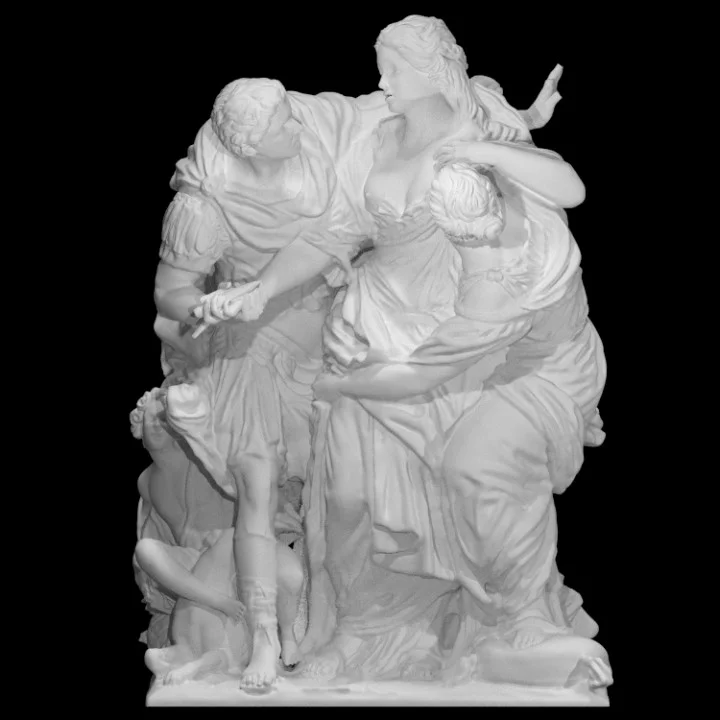
A 3D model of a marble sculpture depicting the Roman story of Arria passing a dagger to her condemned husband, Paetus.

Arria, the wife of Paetus, who was condemned to death by the emperor Claudius, stabbed herself then passed the dagger to her husband, saying: "Paete, non dolet" ("Paetus, it does not hurt"). This subject is characteristic of the "examples of virtue" that constituted an aspect of the historical genre. The Roman senator Caecina Paetus was condemned to death for his involvement in a conspiracy against the Emperor Claudius in AD 42. In order to give him courage, his wife Arria first stabbed herself, then passed the dagger to Paetus saying "Paete, non dolet" ("Paetus, it does not hurt"). There were very few representations of this famous act, recounted by the Latin authors Pliny the Younger (c. AD 61-c. AD 114), Martial (c. AD 40-c. AD 104), Tacitus (c. AD 55-c. AD 120), and Dio Cassius (c. AD 155-c. AD 235); consequently, as of the 18th century, the group was often interpreted as the suicide of Lucretia in the arms of her husband Collatinus.The model was made by Jean-Baptiste Théodon, a French sculptor who worked for many years in Rome; he began to sculpt the marble in 1685. In January 1691, La Tuelière (director of the French Academy in Rome), considering Théodon's progress too slow, entrusted the task to Pierre Lepautre. The date inscribed on the marble (1691) is the year when Lepautre began the work, which he completed in 1695. The sculpture was transported to France in 1715, and installed at the Château de Marly before being moved to the Tuileries Gardens in 1717, as a matching piece for Lepautre's Aeneas and Anchises (in the Louvre). It entered the Louvre in March 1989. This work was clearly not inspired by the famous antique group in the Ludovisi collection (Museo delle Terme, Rome), which was known as Paetus and Arria from 1670. In 1684, François Lespingola made a marble copy (at Versailles) of that antique sculpture (visible in Rome, and reproduced in the collections of engravings by Perrier and Audran) for Louis XIV. However, Théodon and Lepautre's work bears…

Available on

Search by image

Upload a reference to find previews with similar colors, contrast, and detail.

Arria and Paetus at The Louvre, Paris

Arria and Paetus at The Louvre, Paris
MyMiniFactory
3D Models
License not indexed
  • i Check the terms on the original listing.
Show full terms

Arria, the wife of Paetus, who was condemned to death by the emperor Claudius, stabbed herself then passed the dagger to her husband, saying: "Paete, non dolet" ("Paetus, it does not hurt"). This subject is characteristic of the "examples of virtue" that constituted an aspect of the historical genre. The Roman senator Caecina Paetus was condemned to death for his involvement in a conspiracy against the Emperor Claudius in AD 42. In order to give him courage, his wife Arria first stabbed herself, then passed the dagger to Paetus saying "Paete, non dolet" ("Paetus, it does not hurt"). There were very few representations of this famous act, recounted by the Latin authors Pliny the Younger (c. AD 61-c. AD 114), Martial (c. AD 40-c. AD 104), Tacitus (c. AD 55-c. AD 120), and Dio Cassius (c. AD 155-c. AD 235); consequently, as of the 18th century, the group was often interpreted as the suicide of Lucretia in the arms of her husband Collatinus.The model was made by Jean-Baptiste Théodon, a French sculptor who worked for many years in Rome; he began to sculpt the marble in 1685. In January 1691, La Tuelière (director of the French Academy in Rome), considering Théodon's progress too slow, entrusted the task to Pierre Lepautre. The date inscribed on the marble (1691) is the year when Lepautre began the work, which he completed in 1695. The sculpture was transported to France in 1715, and installed at the Château de Marly before being moved to the Tuileries Gardens in 1717, as a matching piece for Lepautre's Aeneas and Anchises (in the Louvre). It entered the Louvre in March 1989. This work was clearly not inspired by the famous antique group in the Ludovisi collection (Museo delle Terme, Rome), which was known as Paetus and Arria from 1670. In 1684, François Lespingola made a marble copy (at Versailles) of that antique sculpture (visible in Rome, and reproduced in the collections of engravings by Perrier and Audran) for Louis XIV. However, Théodon and Lepautre's work bears stylistic similarities to Roman 17th-century sculpture. The figure of Arria was no doubt inspired by Ercole Ferrata's Saint Agnes (1660, Sant'Agnese, Rome); Paetus resembles a figure in Algardi's The Meeting of Attila and Pope Leo (1646-63, Saint Peter's, Rome). The fullness of the figures and drapery resembles that of Roman statuary. The loose folds of Arria's feminine robe contrast with the wide, smooth pleats of the senator's tunic. The artist attempted to convey the meaning of the heroic w

A 3D model of a marble sculpture depicting the Roman story of Arria passing a dagger to her condemned husband, Paetus.

View original listing