GetAssetPack

Athena Lemnia at The Royal Cast Collection, Copenhagen
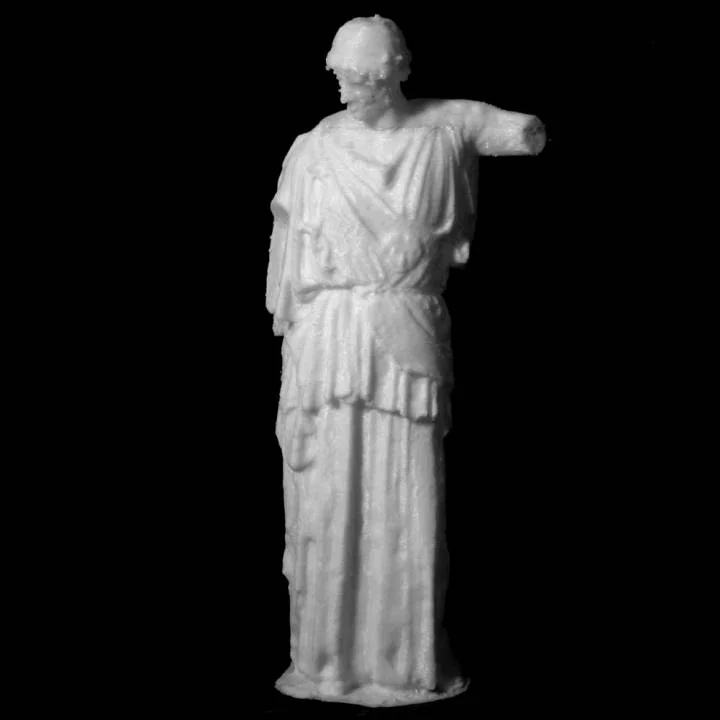
Athena Lemnia at The Royal Cast Collection, Copenhagen
Type
3D Models
Dimensions
3D

The Lemnian Athena, or Athena Lemnia, was a classical Greek statue of the goddess Athena. According to Pausanias (1.28.2), the original bronze was created by Phidias circa 450-440 BCE, for Athenians living on Lemnos to dedicate on the Acropolis inAthens, Greece. It is unclear whether any copies remain. In 1891 Adolf Furtwängler reconstructed two virtually identical, Roman marble statues which he claimed as copies of the original, and identified two Roman marble copies of the head alone. These completed statues were recreated by joining a poorly preserved marble head (Dresden) and a plaster cast of a similar Roman marble head, from the collection of Pelagio Palagi (Bologna), to a pair of identical bodies in Dresden. Both reconstructions and attributions have been disputed; see below. The sculptures concerned are: Two full reconstructions (A and B) in the Staatliche Museum, Albertinum, Dresden, with bodies purchased in 1728 from the Chigi collection, Rome, Italy. The Palagi head at the Archaeological Museum of Bologna, Italy. A further head of this type, found at Pozzuoli is conserved in the Archaeological Museum of the Campi Phlegraei. As reconstructed, the completed statues are pastiches of two Roman marbles, one for the head and the other for the body. Athena wears an unusual, cross-slung aegis decorated with the Gorgon's head. She is bare-headed, without shield, holding her helmet out in her extended right hand, and with her left grasping her spear near the top of the shaft. Furtwängler's identification of the original Athena Lemnia with the Dresden statues and Palagi head was based upon study of an engraved gem and by interpretation of the following passages from Pausanias, Lucian, and Himerios: Pausanias 1.28.2: [On the Acropolis] there are also two other dedications, a statue of Pericles, son of Xanthippos, and the most worth seeing of the works of Phidias, the statue of Athena called the Lemnian after those who dedicated it. Lucian, Imagines 4 and 6: (4)…

Available on

Search by image

Upload a reference to find previews with similar colors, contrast, and detail.

Athena Lemnia at The Royal Cast Collection, Copenhagen

Athena Lemnia at The Royal Cast Collection, Copenhagen
MyMiniFactory
3D Models
License not indexed
  • i Check the terms on the original listing.
Show full terms

The Lemnian Athena, or Athena Lemnia, was a classical Greek statue of the goddess Athena. According to Pausanias (1.28.2), the original bronze was created by Phidias circa 450-440 BCE, for Athenians living on Lemnos to dedicate on the Acropolis inAthens, Greece. It is unclear whether any copies remain. In 1891 Adolf Furtwängler reconstructed two virtually identical, Roman marble statues which he claimed as copies of the original, and identified two Roman marble copies of the head alone. These completed statues were recreated by joining a poorly preserved marble head (Dresden) and a plaster cast of a similar Roman marble head, from the collection of Pelagio Palagi (Bologna), to a pair of identical bodies in Dresden. Both reconstructions and attributions have been disputed; see below. The sculptures concerned are: Two full reconstructions (A and B) in the Staatliche Museum, Albertinum, Dresden, with bodies purchased in 1728 from the Chigi collection, Rome, Italy. The Palagi head at the Archaeological Museum of Bologna, Italy. A further head of this type, found at Pozzuoli is conserved in the Archaeological Museum of the Campi Phlegraei. As reconstructed, the completed statues are pastiches of two Roman marbles, one for the head and the other for the body. Athena wears an unusual, cross-slung aegis decorated with the Gorgon's head. She is bare-headed, without shield, holding her helmet out in her extended right hand, and with her left grasping her spear near the top of the shaft. Furtwängler's identification of the original Athena Lemnia with the Dresden statues and Palagi head was based upon study of an engraved gem and by interpretation of the following passages from Pausanias, Lucian, and Himerios: Pausanias 1.28.2: [On the Acropolis] there are also two other dedications, a statue of Pericles, son of Xanthippos, and the most worth seeing of the works of Phidias, the statue of Athena called the Lemnian after those who dedicated it. Lucian, Imagines 4 and 6: (4) Lykinos: "Of all the works of Phidias, which one do you praise most highly?"Polystratos: "Which if not the Lemnia, on which he thought fit to inscribe his name? Or the Amazon leaning on her spear?...(6) From the Knidia the sculptor [of Panthea] will take only the head, ... allowing the hair, forehead, and that lovely brow-line to remain just as Praxiteles made them, and the liquid yet clear and winsome gaze of the eyes shall stay as Praxiteles conceived it. But he will take the

View original listing