 GetAssetPack
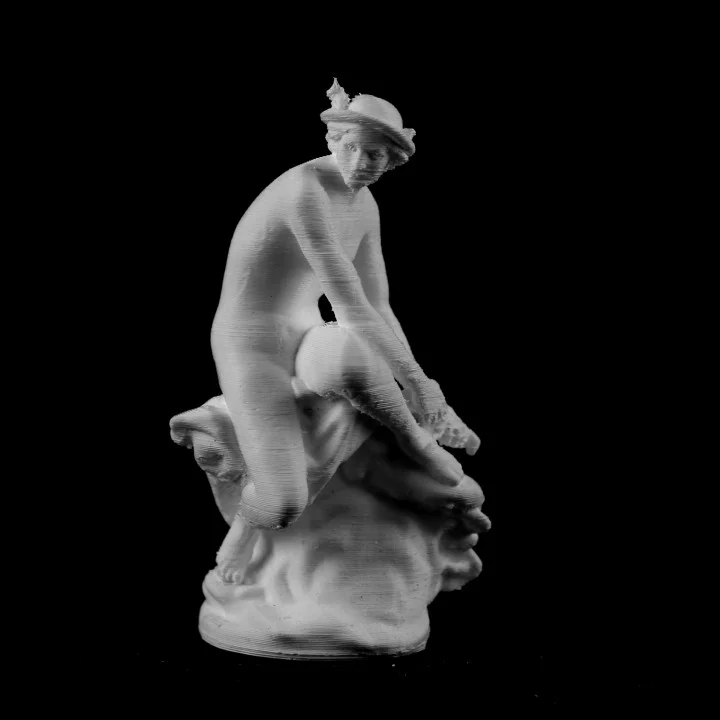
Mercury Attaching his Wings at The Louvre, Paris
- Type
- 3D Models
- Dimensions
- 3D
- Setting
- Fantasy
A 3D model of Mercury seated on a rock and attaching his winged sandals, poised to take flight.
Pigalle's Mercury (approved in 1741) was executed for his admission to the Academy in 1744. The sculptor presented a significantly larger plaster model of this subject at the Salon of 1742, paired with a Venus; both statues were made in marble for the king, and presented in 1750 to Frederick II of Prussia. A twisted position Mercury, the messenger of the gods, is sitting on a rock, ready to leap up. He is attaching the winged sandals which, together with his petasus (winged cap), will enable him to take flight. The god's twisted position and the play of his limbs make the composition interesting to observe from every angle. Mercury is not looking at his talaria (winged sandals) as he attaches them, but his gesture is accentuated by the convergence of both arms and one leg. His crouched position, the upward slant of his limbs and shoulder line, and his face turned to scan the horizon, give an impression of dynamism — that Mercury is about to soar into the sky. The position of his left leg, with his weight on his toes, also suggests that the messenger god is ready for take-off. This pose was perhaps inspired by the Mercury and Argus by Jacob Jordaens (a 17th-century Flemish painter), popularized by engravings. But the play of diagonals and the multiple viewpoints afforded by sculpture in the round enabled Pigalle to add a vitality that transformed the figure of the god into an allegory of speed. Mercury's torso is a variation on the Belvedere Torso (in the Vatican); this antique marble fragment of a muscular seated figure has a strength that fascinated Michelangelo — and has continued to fascinate artists and art lovers. It was left incomplete, which was unusual for the 18th century, and thus became a metaphor for Time that destroys the creations of Genius. It symbolized sculpture, as it does in Jacques Buirette's 1663 reception piece, the bas-relief entitled The Union of Painting and Sculpture (in the Louvre). The Academy reception piece When Pigalle returned to…