GetAssetPack

Alexander The Great at The Louvre, Paris
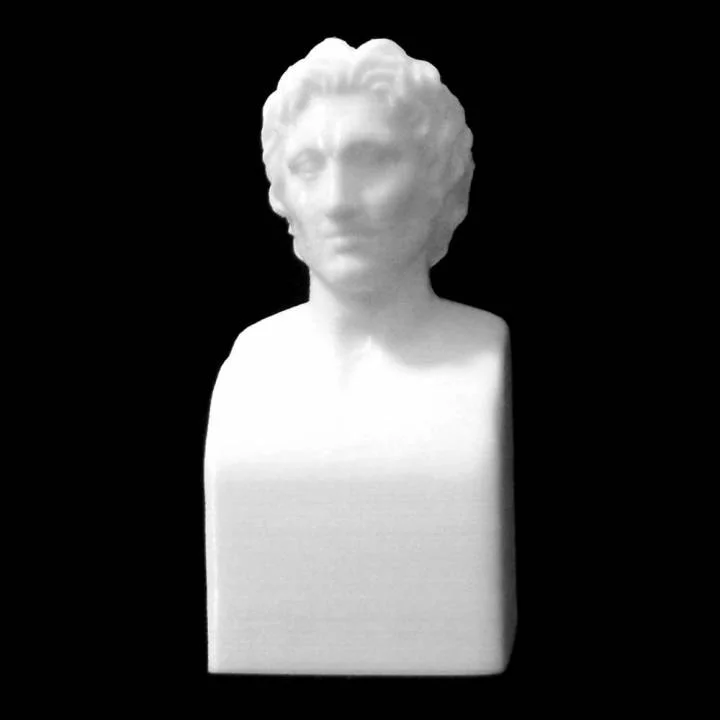
Alexander The Great at The Louvre, Paris
Type
3D Models
Dimensions
3D

Thanks to its original antique inscription, this figure can be definitely identified as Alexander the Great, son of Philip II of Macedon. The leonine hair brushed up from the forehead is characteristic of portraits of the Macedonian sovereign. The work is a copy of the head of a work from 330 BC attributed to Lysippos - doubtless the statue of Alexander with a bronze lance mentioned by Plutarch (Moralia, 360 d). The Louvre's small bronze, Br 370, is another copy of the same work. This work takes the form of a herm: a pillar whose upper part has been sculpted in the shape of a head. It shows a young man, his head slightly lifted. The features are idealized, but there is a a degree of individualization in his inspired expression, and the mane of hair falling in strands on his forehead. The authenticity of the antique inscription - which identifies the bust as that of Alexander the Great - is open to discussion, but the physiognomy of the figure leaves no doubt. The particular arrangement of the hair is well attested in other images of the Macedonian conqueror. This bust was part of a gallery of herms featuring portraits of famous men, unearthed in 1779 during an excavation at Tivoli organized by Joseph Nicolas Azara, the Spanish ambassador to the Holy See and, later, to France. For a time, this was the only known portrait of Alexander the Great; the value and significance of Azara's gift of it to Napoleon Bonaparte was, then, considerable. The date of the presentation is uncertain: according to some texts, Azara intended to offer it as a diplomatic gift during the negotiations surrounding the Armistice of Bologna in 1796, as a gauge of the Holy See's good will towards . Nevertheless, the inscription tells us that Napoleon received the herm during his time as First Consul, ie. not before 1803, the year in which he gave the work to the Louvre (as indicated by the inscription on the right-hand side of the pillar). The inscription, together with Bonaparte's other…

Available on

Search by image

Upload a reference to find previews with similar colors, contrast, and detail.

Alexander The Great at The Louvre, Paris

Alexander The Great at The Louvre, Paris
MyMiniFactory
3D Models
License not indexed
  • i Check the terms on the original listing.
Show full terms

Thanks to its original antique inscription, this figure can be definitely identified as Alexander the Great, son of Philip II of Macedon. The leonine hair brushed up from the forehead is characteristic of portraits of the Macedonian sovereign. The work is a copy of the head of a work from 330 BC attributed to Lysippos - doubtless the statue of Alexander with a bronze lance mentioned by Plutarch (Moralia, 360 d). The Louvre's small bronze, Br 370, is another copy of the same work. This work takes the form of a herm: a pillar whose upper part has been sculpted in the shape of a head. It shows a young man, his head slightly lifted. The features are idealized, but there is a a degree of individualization in his inspired expression, and the mane of hair falling in strands on his forehead. The authenticity of the antique inscription - which identifies the bust as that of Alexander the Great - is open to discussion, but the physiognomy of the figure leaves no doubt. The particular arrangement of the hair is well attested in other images of the Macedonian conqueror. This bust was part of a gallery of herms featuring portraits of famous men, unearthed in 1779 during an excavation at Tivoli organized by Joseph Nicolas Azara, the Spanish ambassador to the Holy See and, later, to France. For a time, this was the only known portrait of Alexander the Great; the value and significance of Azara's gift of it to Napoleon Bonaparte was, then, considerable. The date of the presentation is uncertain: according to some texts, Azara intended to offer it as a diplomatic gift during the negotiations surrounding the Armistice of Bologna in 1796, as a gauge of the Holy See's good will towards . Nevertheless, the inscription tells us that Napoleon received the herm during his time as First Consul, ie. not before 1803, the year in which he gave the work to the Louvre (as indicated by the inscription on the right-hand side of the pillar). The inscription, together with Bonaparte's other imperial symbols, was probably made after his downfall in 1815. This bust was badly damaged during its time underground, and has been extensively restored. It is, nevertheless, the portrait of Alexander that comes closest to the work of Lysippos, a Greek artist of the fourth century BC. Lysippos's fame is due as much to his works in bronze as to his status as Alexander's official portraitist. Contemporary sources tell us that the sovereign authorized only three such artists: the sculptor Lysippos, th

View original listing