GetAssetPack

Aphrodite at The Louvre, Paris
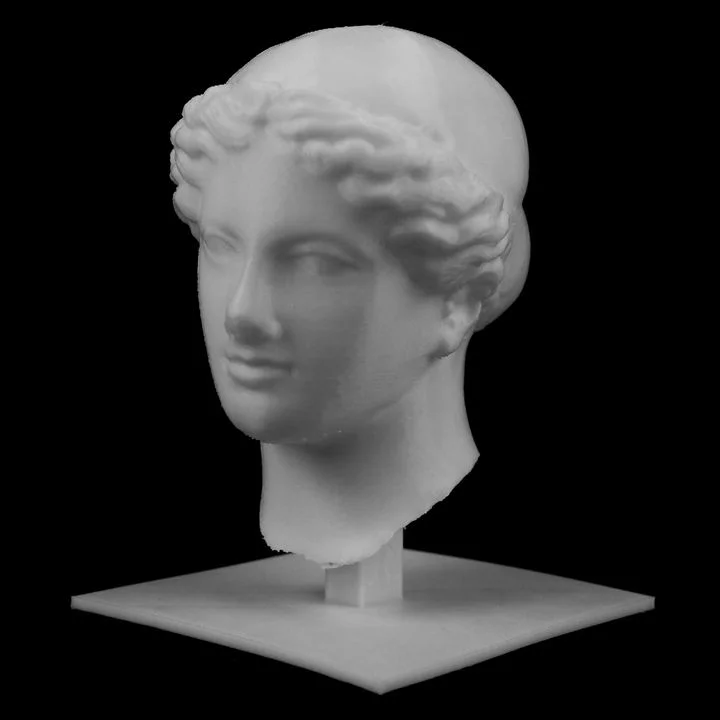
Aphrodite at The Louvre, Paris
Type
3D Models
Dimensions
3D

A marble Hellenistic-era head of Aphrodite, based on the Aphrodite of Cnidus.

Among the many copies inspired by the Aphrodite of Cnidus, this head from the former Kaufmann Collection is a Hellenistic-era creation. It is distinguished by its grace and delicacy. The sculptor freely adapted Praxiteles' masterpiece of the mid-fourth century BC, without altering either its religious nobility or its sensuality. The goddess performs her ablutions completely naked, an audacious and novel treatment of the subject. The "Kaufmann Head" This head of Aphrodite was discovered at Tralles in Asia Minor circa 1885. It takes its current name from the Kaufmann Collection, where it was preserved until it was purchased by the Louvre in 1951. A fragment from the same statue, depicting the pelvis and upper thighs, is in the collections of the Staatliche Museen in Berlin. The "Kaufmann Head" is one of a great many copies that were made of the Aphrodite of Cnidus in the Hellenistic and Imperial periods. The slight tilt to the left, the chignon, and the treatment of the hair in waves divided equally on either side of a central part are fairly similar to other Roman heads in the vicinity of this piece. The head is distinguished by its grace and gentleness, and there are no trepan lines in the working of the hair - these clues allow us to date this work to the Hellenistic period. An original creation based on the Aphrodite of Cnidus by Praxiteles More than a simple copy, this marble head from the Kaufmann Collection offers us an original creation from the second century BC. The sculptor has taken several liberties with the famous statue created by Praxiteles, an Athenian sculptor of the mid-fourth century BC, without altering either the goddess's religious nobility or her sensuality. He or she has accented the length of the neck and noticeably lengthened the face's delicate oval. The sculptor has also changed the arrangement of the ribbons holding the hair: here the two ribbons are parallel, while on other copies they diverge. Aphrodite thus appears more tentative and…

Available on

Search by image

Upload a reference to find previews with similar colors, contrast, and detail.

Aphrodite at The Louvre, Paris

Aphrodite at The Louvre, Paris
MyMiniFactory
3D Models
License not indexed
  • i Check the terms on the original listing.
Show full terms

Among the many copies inspired by the Aphrodite of Cnidus, this head from the former Kaufmann Collection is a Hellenistic-era creation. It is distinguished by its grace and delicacy. The sculptor freely adapted Praxiteles' masterpiece of the mid-fourth century BC, without altering either its religious nobility or its sensuality. The goddess performs her ablutions completely naked, an audacious and novel treatment of the subject. The "Kaufmann Head" This head of Aphrodite was discovered at Tralles in Asia Minor circa 1885. It takes its current name from the Kaufmann Collection, where it was preserved until it was purchased by the Louvre in 1951. A fragment from the same statue, depicting the pelvis and upper thighs, is in the collections of the Staatliche Museen in Berlin. The "Kaufmann Head" is one of a great many copies that were made of the Aphrodite of Cnidus in the Hellenistic and Imperial periods. The slight tilt to the left, the chignon, and the treatment of the hair in waves divided equally on either side of a central part are fairly similar to other Roman heads in the vicinity of this piece. The head is distinguished by its grace and gentleness, and there are no trepan lines in the working of the hair - these clues allow us to date this work to the Hellenistic period. An original creation based on the Aphrodite of Cnidus by Praxiteles More than a simple copy, this marble head from the Kaufmann Collection offers us an original creation from the second century BC. The sculptor has taken several liberties with the famous statue created by Praxiteles, an Athenian sculptor of the mid-fourth century BC, without altering either the goddess's religious nobility or her sensuality. He or she has accented the length of the neck and noticeably lengthened the face's delicate oval. The sculptor has also changed the arrangement of the ribbons holding the hair: here the two ribbons are parallel, while on other copies they diverge. Aphrodite thus appears more tentative and fragile, but both the memory of the subject and the style of Praxiteles's creation remain, particularly in the sfumato effect emanating from the face. An Aphrodite in her bath In the fourth century BC, the citizens of Cnidus, a small city-state on the southern coast of Asia Minor, placed the Aphrodite of Praxiteles in the heart of the temple dedicated to her. Viewers were struck by the boldness of the subject - the first large-scale Greek statue to depict the female nude - as well as the qu

A marble Hellenistic-era head of Aphrodite, based on the Aphrodite of Cnidus.

View original listing