GetAssetPack

Hermes fastening his sandal at the Institut für Klassische Archäologie, Vienna
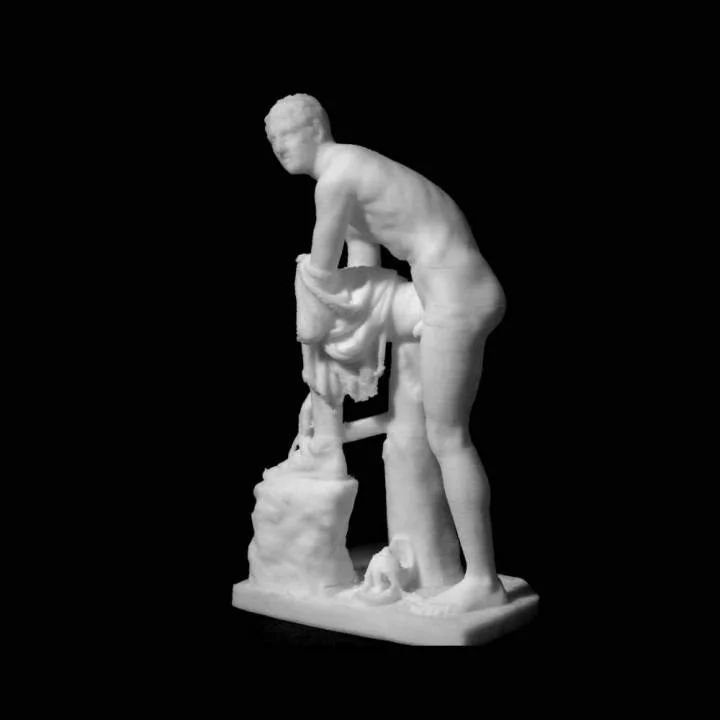
Hermes fastening his sandal at the Institut für Klassische Archäologie, Vienna
Type
3D Models
Dimensions
3D

The sculptures of Hermes Fastening his Sandal, which exist in several versions, are all Roman marble copies of a lost Greek bronze original in the manner of Lysippos, dating to the fourth century BCE. The identity of the subject, which may simply represent an idealized athlete is conventional. No attribute in any of the surviving examples clearly identifies Hermes, who wears neither hat nor helmet; none of the surviving original sandals are represented as winged. A pair of sandals figures in the myth of Theseus, and when the painter-dealer Gavin Hamilton uncovered an example in the swamp ground called the Pantanello at Hadrian's Villa at Tivoli in 1769, he hesitated between calling it a Theseus or a Cincinnatus. Jason's myth also involves a lost sandal. When Augustus Hare saw that sculpture in the Ball Room of Lansdowne House (the Earl of Shelburne having been created Marquess of Lansdowne in 1784), in Berkeley Square, he noted it as "Jason fastening his sandal." The identification with Hermes is based on an identification of the original bronze model as a sculpture of Hermes in the gymnasium and thermae of Zeuxippos in Constantinople, which was described in detail by Christodoros of Koptos in his ekphrasis of the gymnasium as it still remained in Late Antiquity: "There was Hermes, of the golden wand. He stood and fastened up the thongs of his winged sandal with his right hand, yearning to rush forth upon his course. His swift right leg was bent at the knee, and on it he rested his left hand, and meanwhile he was turning his face up to heaven, as if he were hearing the commands of his king and father" Brunilde Sismondo Ridgway prefers to call the subject The Sandal-Binder or Jason; she notes, that, from the finding sites, the sculpture appears to have been popular in gardens and gymnasia. Judging from the fully lifesize scale of the copies and their generally high quality, the original bronze must have been respected as one of the received masterpieces in the canon…

Available on

Search by image

Upload a reference to find previews with similar colors, contrast, and detail.

Hermes fastening his sandal at the Institut für Klassische Archäologie, Vienna

Hermes fastening his sandal at the Institut für Klassische Archäologie, Vienna
MyMiniFactory
3D Models
License not indexed
  • i Check the terms on the original listing.
Show full terms

The sculptures of Hermes Fastening his Sandal, which exist in several versions, are all Roman marble copies of a lost Greek bronze original in the manner of Lysippos, dating to the fourth century BCE. The identity of the subject, which may simply represent an idealized athlete is conventional. No attribute in any of the surviving examples clearly identifies Hermes, who wears neither hat nor helmet; none of the surviving original sandals are represented as winged. A pair of sandals figures in the myth of Theseus, and when the painter-dealer Gavin Hamilton uncovered an example in the swamp ground called the Pantanello at Hadrian's Villa at Tivoli in 1769, he hesitated between calling it a Theseus or a Cincinnatus. Jason's myth also involves a lost sandal. When Augustus Hare saw that sculpture in the Ball Room of Lansdowne House (the Earl of Shelburne having been created Marquess of Lansdowne in 1784), in Berkeley Square, he noted it as "Jason fastening his sandal." The identification with Hermes is based on an identification of the original bronze model as a sculpture of Hermes in the gymnasium and thermae of Zeuxippos in Constantinople, which was described in detail by Christodoros of Koptos in his ekphrasis of the gymnasium as it still remained in Late Antiquity: "There was Hermes, of the golden wand. He stood and fastened up the thongs of his winged sandal with his right hand, yearning to rush forth upon his course. His swift right leg was bent at the knee, and on it he rested his left hand, and meanwhile he was turning his face up to heaven, as if he were hearing the commands of his king and father" Brunilde Sismondo Ridgway prefers to call the subject The Sandal-Binder or Jason; she notes, that, from the finding sites, the sculpture appears to have been popular in gardens and gymnasia. Judging from the fully lifesize scale of the copies and their generally high quality, the original bronze must have been respected as one of the received masterpieces in the canon of antiquity (Ridgeway 1964:120). Three moderately complete Roman marble copies have survived. The Louvre Hermes Fastening his Sandal  (illustration) was the first to be discovered. Haskell and Penny note that an engraving of it was published in 1594, where it was described as the property of Alessandro Peretti Cardinal di Montalto and was doubtless already in the Villa Peretti di Montalto, which the very young Cardinal's uncle Pope Sixtus V, had recently built; it was recorded there in 1

View original listing