GetAssetPack

King Uthal

King Uthal
Type
3D Models
Dimensions
3D

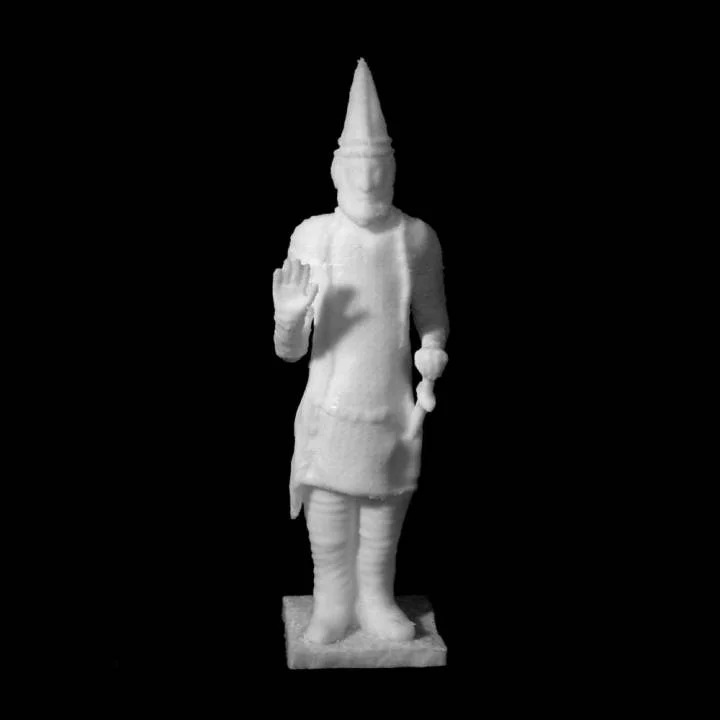
This image of King Uthal is the finest of all the sculptures unearthed in Hatra and was discovered in the first stage of excavation in 1951 in the Third Temple - usually called Baalshamin Temple. The head and the body of this marble sculpture (which stands a little larger than life), were discovered separately. The reason seems to be that the statue had suffered the ravages of war when the Persian army under the command of Shapur I of the Sasanian Dynasty invaded Hatra. A glance at the statue will make you feel the strong emphasis on the frontality of the image. This is the same characteristic which is apparent in the bronze statue of a Parthian nobleman (at the National Museum of Iran, see below) unearthed in the Shami Temple on the Iranian highlands. The King stands erect with his left lef placed forward, his left hand resting on the handle of his long sword and his right hand extended palm-outward in a prayer for peace. On his head rests a long crown peculiar to Hatra, while the trousers in the Parthian manner cover his lower form. On his upper frame, reaching as far down as his knees, is a long coat, on top of which the King wears an over-coat of furry material. Viewed from sideways, the peculiary Hatrian crown has a sprinkling of precious stones in squares composed of a series of pearl-like objects. The lower end of the crown is tied to the King's head by leathery strings. The extremities of the strings which come floating down the King's back are left unformed, as the back of the King himself is left unfinished. The King has his eyes wide open - indeed, they look like apricots in form. The pupils of the eyes were slightly upward probably because of their near-upper-lid position. The nose is high and shapely, while a thick mustache hangs over the King's mouth, with both ends slightly turned upward. Both of the King's ears are adorned with earrings, while rich bushes of sideburns expressed in simple carved lines in parallel transform themselves into beards. The…

Available on

Search by image

Upload a reference to find previews with similar colors, contrast, and detail.

King Uthal

King Uthal
MyMiniFactory
3D Models
License not indexed
  • i Check the terms on the original listing.
Show full terms

This image of King Uthal is the finest of all the sculptures unearthed in Hatra and was discovered in the first stage of excavation in 1951 in the Third Temple - usually called Baalshamin Temple. The head and the body of this marble sculpture (which stands a little larger than life), were discovered separately. The reason seems to be that the statue had suffered the ravages of war when the Persian army under the command of Shapur I of the Sasanian Dynasty invaded Hatra. A glance at the statue will make you feel the strong emphasis on the frontality of the image. This is the same characteristic which is apparent in the bronze statue of a Parthian nobleman (at the National Museum of Iran, see below) unearthed in the Shami Temple on the Iranian highlands. The King stands erect with his left lef placed forward, his left hand resting on the handle of his long sword and his right hand extended palm-outward in a prayer for peace. On his head rests a long crown peculiar to Hatra, while the trousers in the Parthian manner cover his lower form. On his upper frame, reaching as far down as his knees, is a long coat, on top of which the King wears an over-coat of furry material. Viewed from sideways, the peculiary Hatrian crown has a sprinkling of precious stones in squares composed of a series of pearl-like objects. The lower end of the crown is tied to the King's head by leathery strings. The extremities of the strings which come floating down the King's back are left unformed, as the back of the King himself is left unfinished. The King has his eyes wide open - indeed, they look like apricots in form. The pupils of the eyes were slightly upward probably because of their near-upper-lid position. The nose is high and shapely, while a thick mustache hangs over the King's mouth, with both ends slightly turned upward. Both of the King's ears are adorned with earrings, while rich bushes of sideburns expressed in simple carved lines in parallel transform themselves into beards. The statue has a metal choker around its throat and a metal sword belt around its waist. At both sides of the buckle are open-work griffins with stately wings. On the part of the sword where the leather belt comes through, there are also open-work animals - this time without wings and which look like either lions or dragons. On the surface of the upper coat, there are the same ornamental patterns as those found on the crown - comma-shaped beads (probably gems) composed of a series of pearl-l

View original listing