GetAssetPack

Octave Auguste at The Louvre, Lens
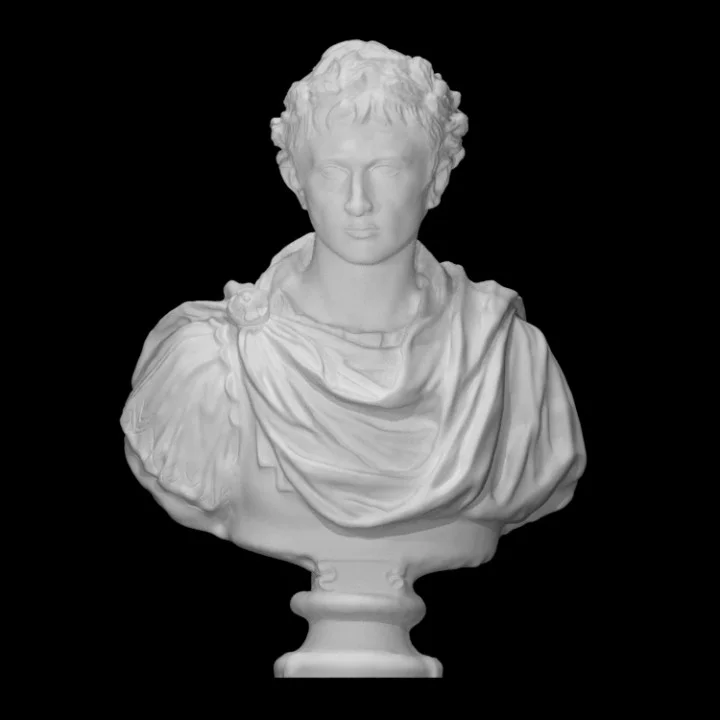
Octave Auguste at The Louvre, Lens
Type
3D Models
Dimensions
3D

This marble bust depicts Augustus (23 September 63 BC – 19 August 14 AD) the founder of the Roman Empire and its first Emperor, ruling from 27 BC until his death in 14 AD.[note 3] He was born Gaius Octavius into an old and wealthy equestrian branch of the plebeian Octavii family. Following the assassination of his maternal great-uncle Julius Caesar in 44 BC, Caesar's will named Octavius as his adopted son and heir. Together with Mark Antony and Marcus Lepidus, he formed the Second Triumvirate to defeat the assassins of Caesar. Following their victory at Philippi, the Triumvirate divided the Roman Republic among themselves and ruled as military dictators.[note 4] The Triumvirate was eventually torn apart under the competing ambitions of its members: Lepidus was driven into exile and stripped of his position, and Antony committed suicide following his defeat at the Battle of Actium by Augustus in 31 BC. After the demise of the Second Triumvirate, Augustus restored the outward facade of the free Republic, with governmental power vested in the Roman Senate, the executive magistrates, and the legislative assemblies. In reality, however, he retained his autocratic power over the Republic as a military dictator. By law, Augustus held a collection of powers granted to him for life by the Senate, including supreme military command, and those of tribune and censor. It took several years for Augustus to develop the framework within which a formally republican state could be led under his sole rule. He rejected monarchical titles, and instead called himself Princeps Civitatis ("First Citizen of the State"). The resulting constitutional framework became known as thePrincipate, the first phase of the Roman Empire. The reign of Augustus initiated an era of relative peace known as thePax Romana (The Roman Peace). Despite continuous wars of imperial expansion on the Empire's frontiers and one year-long civil war over the imperial succession, the Roman world was largely free from…

Available on

Search by image

Upload a reference to find previews with similar colors, contrast, and detail.

Octave Auguste at The Louvre, Lens

Octave Auguste at The Louvre, Lens
MyMiniFactory
3D Models
License not indexed
  • i Check the terms on the original listing.
Show full terms

This marble bust depicts Augustus (23 September 63 BC – 19 August 14 AD) the founder of the Roman Empire and its first Emperor, ruling from 27 BC until his death in 14 AD.[note 3] He was born Gaius Octavius into an old and wealthy equestrian branch of the plebeian Octavii family. Following the assassination of his maternal great-uncle Julius Caesar in 44 BC, Caesar's will named Octavius as his adopted son and heir. Together with Mark Antony and Marcus Lepidus, he formed the Second Triumvirate to defeat the assassins of Caesar. Following their victory at Philippi, the Triumvirate divided the Roman Republic among themselves and ruled as military dictators.[note 4] The Triumvirate was eventually torn apart under the competing ambitions of its members: Lepidus was driven into exile and stripped of his position, and Antony committed suicide following his defeat at the Battle of Actium by Augustus in 31 BC. After the demise of the Second Triumvirate, Augustus restored the outward facade of the free Republic, with governmental power vested in the Roman Senate, the executive magistrates, and the legislative assemblies. In reality, however, he retained his autocratic power over the Republic as a military dictator. By law, Augustus held a collection of powers granted to him for life by the Senate, including supreme military command, and those of tribune and censor. It took several years for Augustus to develop the framework within which a formally republican state could be led under his sole rule. He rejected monarchical titles, and instead called himself Princeps Civitatis ("First Citizen of the State"). The resulting constitutional framework became known as thePrincipate, the first phase of the Roman Empire. The reign of Augustus initiated an era of relative peace known as thePax Romana (The Roman Peace). Despite continuous wars of imperial expansion on the Empire's frontiers and one year-long civil war over the imperial succession, the Roman world was largely free from large-scale conflict for more than two centuries. Augustus dramatically enlarged the Empire, annexing Egypt, Dalmatia, Pannonia, Noricum, and Raetia, expanded possessions in Africa, expanded into Germania, and completed the conquest of Hispania. Beyond the frontiers, he secured the Empire with a buffer region ofclient states, and made peace with the Parthian Empire through diplomacy. He reformed the Roman system of taxation, developednetworks of roads with an official courier system, establishe

View original listing