GetAssetPack

Dtto - Modular Exploration Robot
Dtto - Modular Exploration Robot
Type
3D Models
Dimensions
3D

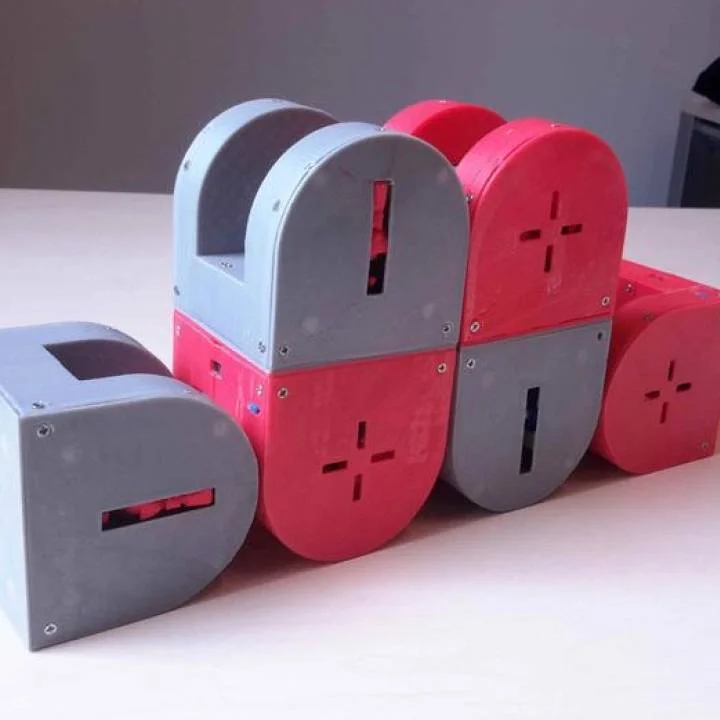
Designed by Alberto KL and Nathan | Licensed under CC BY-SA 4.0 Dtto Modular Exploration Robot Assembly Guide The Dtto Robot is a 3D printable modular exploration robot capable of adapting to various situations through self-reconfiguration, by changing the position and connections of the individual modules. Inspired by how fire ants colonies work, a number of modules (or small robots) find each other, connect mechanically and collaborate to act as one only robot, creating a collective intelligence. They can link together and build structures without any central command. The advantage of being all modules the same is that, if one of them breaks, it can easily get replaced by another one, creating a self-healing structure. This robot is aimed for research on modular self-reconfigurable robots and educational purposes. It is designed to allow multiple modules to communicate, mechanically connect, and to work collaboratively in the locomotion, self-reconfigurability, and efficient movement. “You must be shapeless, formless, like water. When you pour water in a cup, it becomes the cup. When you pour water in a bottle, it becomes the bottle. When you pour water in a teapot, it becomes the teapot. Become like water my friend.” - Bruce Lee The Problem In most natural disaster situations, like hurricanes, earthquakes, fires, there are situations where people get trapped without the possibility to get out to safety by themselves. Then is when search and rescue operation teams come at play. Nowadays, most of the search and rescue operations are carried out by humans, needing a lot of specialized manpower and hours of work to look for possible survivors. After working at Ground Zero on the WTC, Dr. Robin Murphy, Professor of Computer Science at University of South Florida, who was working with search and rescue robots, said: “Robots proved helpful” ; “Using robots can minimize the number of personnel on site, and reduce the fatigue and errors” ; She sees mobile robots as…

Available on

Search by image

Upload a reference to find previews with similar colors, contrast, and detail.

Dtto - Modular Exploration Robot

Dtto - Modular Exploration Robot
MyMiniFactory
3D Models
License not indexed
  • i Check the terms on the original listing.
Show full terms

Designed by Alberto KL and Nathan | Licensed under CC BY-SA 4.0 Dtto Modular Exploration Robot Assembly Guide The Dtto Robot is a 3D printable modular exploration robot capable of adapting to various situations through self-reconfiguration, by changing the position and connections of the individual modules. Inspired by how fire ants colonies work, a number of modules (or small robots) find each other, connect mechanically and collaborate to act as one only robot, creating a collective intelligence. They can link together and build structures without any central command. The advantage of being all modules the same is that, if one of them breaks, it can easily get replaced by another one, creating a self-healing structure.  This robot is aimed for research on modular self-reconfigurable robots and educational purposes. It is designed to allow multiple modules to communicate, mechanically connect, and to work collaboratively in the locomotion, self-reconfigurability, and efficient movement. “You must be shapeless, formless, like water. When you pour water in a cup, it becomes the cup. When you pour water in a bottle, it becomes the bottle. When you pour water in a teapot, it becomes the teapot. Become like water my friend.” - Bruce Lee  The Problem In most natural disaster situations, like hurricanes, earthquakes, fires, there are situations where people get trapped without the possibility to get out to safety by themselves. Then is when search and rescue operation teams come at play. Nowadays, most of the search and rescue operations are carried out by humans, needing a lot of specialized manpower and hours of work to look for possible survivors. After working at Ground Zero on the WTC, Dr. Robin Murphy, Professor of Computer Science at University of South Florida, who was working with search and rescue robots, said: “Robots proved helpful” ; “Using robots can minimize the number of personnel on site, and reduce the fatigue and errors” ; She sees mobile robots as scouts able to navigate, adapt and perceive. ; ”Robots will be man-packable” ; “so small that they can fit into small subhuman confines, able to tell their orientation as they snake through open spaces in rubble” ; “...going where no human should go”. How it works In robotics, the usual approach for designing exploration robots is: First, study the terrain characteristics and then, designing a robot according to those needs. When moving trough an unexplored and unpredictable terrain l

View original listing