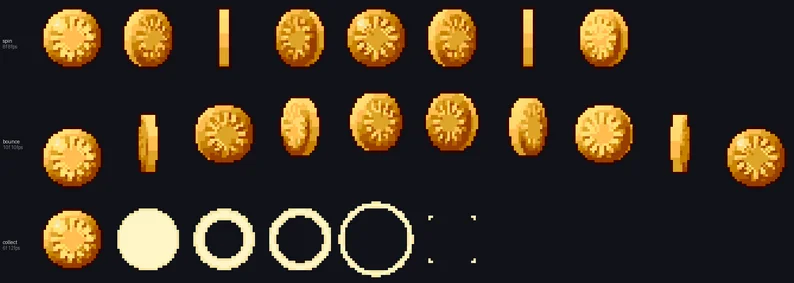
Twenty-five designs struck in six metals, at 32×32 native — not upscaled from 16. Each coin ships three animations, not one: an 8-frame spin that loops, a 10-frame bounce for when it pops out of a block, and a 6-frame collect burst for the moment the player takes it.
3,600 animated frames. Drop one in and the coin is already doing everything your game will ask of it.
Show full description...
animationframesfpscanvas
spin 8 8 32×32, loops
bounce 10 10 32×48
collect 6 12 32×32
The six metals are denominations, not recolours
This is the part most coin packs skip. Each metal is a different diameter, so a player can read the value off the size without a number anywhere on screen — the way Terraria does it.
metalvaluediameteredgecharacter
Copper ×1 20 px 4 px warm, dull, corroded rim
Iron ×5 22 px 6 px cold, heavy, no shine at all
Silver ×10 24 px 4 px cool, hard, sharp white flash
Gold ×50 26 px 6 px saturated, wide warm flash
Emerald ×100 28 px 4 px gem — light crosses it
Diamond ×500 30 px 4 px gem — flashes on the edge frame
Iron having no highlight is deliberate. Two grey metals separated only by hue stop being distinguishable at 32 pixels, so silver keeps the mirror and iron gives it up entirely. Copper's rim is eaten away for the same reason — it has to differ from gold in more than temperature.
The value ladder is a suggestion. The files are named by metal; ignore the numbers and use whichever six you like.
Fourteen outlines, twelve struck faces
Discs. Holed coins on a string. Square-holed cash coins. A tall oblong. A rhombus. A Reuleaux triangle — the one shape whose width does not change as it turns. Hacksilver cut in half with an axe. A ring with a segment snapped out. A scalloped rim, a four-notch rim, a pierced amulet on a loop.
Struck with rings, a raised boss, a sunburst, a cross, Roman numerals, a skull, a star, a crown, an eye.
Every design differs from every other in silhouette, not just in colour. That matters more here than on a static icon: for two of the eight spin frames the silhouette is the only thing on screen.
Verified across frames, not just as stills
Any pack can look right in a screenshot. These are checked while they move, and the build fails if one does not pass. Every result is recorded per coin in coins.json.
- No wobble — the centre of mass moves under 0.55 px across a full turn. Worst case in this release: 0.40 px. A drifting centre is invisible in any single frame and unmistakable the moment it plays, which is exactly how it survives to release in packs that only check images.
- Smooth turn — the width sequence is symmetric and never reverses, so the coin does not speed up and slow down for no reason.
- Never vanishes — every frame is at least 4 px wide. A coin that disappears edge-on reads as a bug in your game, not as a coin.
- One flash per half turn — it never strobes.
- Ten colours per metal, one shared palette, strictly binary alpha — no semi-transparent pixel anywhere.
What's inside
mintmark/ ├── singles/ 150 face-on PNGs — inventory icons ├── spin/ frames · strips (+Aseprite JSON) · GIF ├── bounce/ frames · strips (+Aseprite JSON) · GIF ├── collect/ frames · strips (+Aseprite JSON) · GIF ├── atlas/ one sheet per animation per metal ├── palette/ .gpl · .hex · palette strip ├── preview.html all 150 animating, offline, no server ├── CATALOGUE.png · coins.json · README.md · LICENSE.txt
5,155 files. 12 MB unpacked.
Individual frames and strips, never one or the other. The strip is what a finished project imports; the single file is what you drag into a scene to see whether you like it.
Strips carry no padding — Godot's hframes and Unity's grid slicer both break on a gutter. The multi-coin atlases carry a 2 px gutter, because that is where different sprites sit next to each other and a mis-set filter really can bleed one into another.
The GIFs are previews. No engine imports a GIF as a sprite animation. They are there so you can check the loop before you import.
No generative AI
Procedurally generated from a geometric model of a metal plate turning about an axis. No model, no training data, no generative system anywhere in it — every pixel is deterministic and reproducible.
Import settings
Unity — Filter Mode Point (no filter) · Compression None · Pixels Per Unit 32 · Mip Maps off · Sprite Mode Multiple → Grid By Cell Size 32×32 (bounce: 32×48) · Pivot Bottom for bounce.
Godot 4 — Rendering ▸ Textures ▸ Default Texture Filter Nearest · Mipmaps off · Compression Lossless · AnimatedSprite2D with hframes set to the frame count.
Everyone — integer scaling only, ×1 ×2 ×3. Any fractional zoom breaks the pixel grid whatever the filter says.
Licence
Use it in anything — personal or commercial, any revenue, any number of projects. Modify it freely. Credit appreciated, never required.
Do not resell the assets as assets, in this pack or repackaged inside another. Ship them in a game: yes. Sell them as art: no.
Full terms in LICENSE.txt, and that file is the licence — if this page ever disagrees with it, the file wins.
Made with Boneglass, a structure-driven procedural pixel art tool. Every coin is generated from one geometric model, which is why 150 of them are consistent with each other down to the pixel.
 GetAssetPack