GetAssetPack

Old Mosque in Edirne

Old Mosque in Edirne
Price
Free
Type
3D Models
Dimensions
3D
Setting
Asian

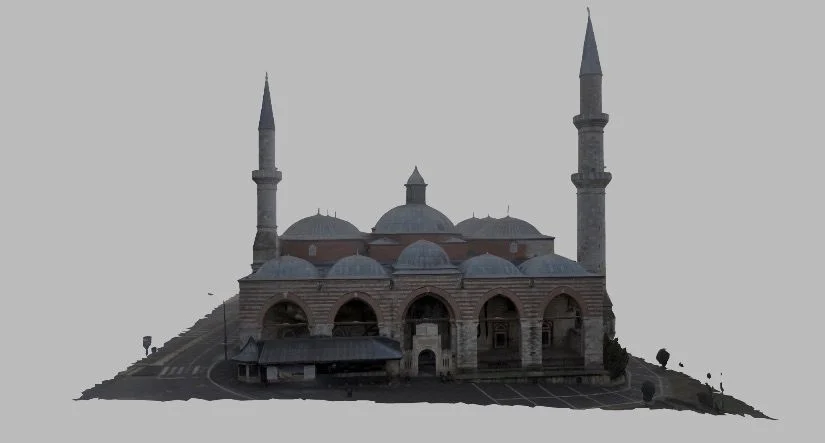
Interactive 3D model of Edirne's Ottoman Old Mosque, with a prayer hall featuring twenty domes and twelve limestone columns.

Explore Old Mosque in Edirne with an interactive 3D model on FUNES.WORLD. Beneath twenty domes suspended like ink-dipped moons, Eski Cami’s prayer hall stretches as a sanctuary of shadows and revelation. Built between 1403–1414 during the Ottoman Empire’s fracturing and rebirth, this hypostyle labyrinth of twelve limestone columns and 40,000 bricks is no mere mosque—it is a stone parchment where Quranic verses breathe through walls, and the very air thrums with the unresolved tensions of an empire reforging itself. Step into the forest of columns, each a silent sentinel bearing the weight of six centuries. Their capitals—repurposed Roman-era marble from nearby Aenus—anchor a grid of domes that prefigure Istanbul’s grand mosques. In 2021, LiDAR scans revealed these pillars tilt 0.3° northwest, not from subsidence, but because Mehmed I’s architects aligned them with the Kaaba’s magnetic bearing. The dome arrangement follows a celestial cipher: twenty cupolas mapping the lunar cycle’s brightest nights for Ramadan observances. But the true soul of Eski Cami lives in its calligraphy. Şeyh Hamdullah’s Ayat al-Kursi unfurls above the mihrab in thuluth script so fluid, restorers in 1987 found brush hairs embedded in the pigment—traces of the master’s hand trembling as Süleyman Çelebi’s empire crumbled. Ultraviolet scans exposed layers beneath: erased Byzantine hymns in Greek uncials, their curves fossilized under Ottoman gold leaf. The northern wall’s Surah al-Fath panel hides a cryptographic puzzle: certain letters subtly enlarged to spell “Allah” vertically, a clandestine declaration of faith during Edirne’s 1913 Bulgarian occupation. Time’s erosion becomes collaborator. Centuries of oil lamps have patinated the western columns’ limestone into a dendritic black, their branching patterns mirroring the Maritsa River’s delta visible from the minaret. The 19th-century şadırvan, its octagonal basin cracked by frost heave, now hosts a colony of endangered Balkan stream…

Available on

Search by image

Upload a reference to find previews with similar colors, contrast, and detail.

Old Mosque in Edirne

Old Mosque in Edirne
FunesFree
3D Models
License not indexed
  • i Check the terms on the original listing.
Show full terms

Explore Old Mosque in Edirne with an interactive 3D model on FUNES.WORLD. Beneath twenty domes suspended like ink-dipped moons, Eski Cami’s prayer hall stretches as a sanctuary of shadows and revelation. Built between 1403–1414 during the Ottoman Empire’s fracturing and rebirth, this hypostyle labyrinth of twelve limestone columns and 40,000 bricks is no mere mosque—it is a stone parchment where Quranic verses breathe through walls, and the very air thrums with the unresolved tensions of an empire reforging itself. Step into the forest of columns, each a silent sentinel bearing the weight of six centuries. Their capitals—repurposed Roman-era marble from nearby Aenus—anchor a grid of domes that prefigure Istanbul’s grand mosques. In 2021, LiDAR scans revealed these pillars tilt 0.3° northwest, not from subsidence, but because Mehmed I’s architects aligned them with the Kaaba’s magnetic bearing. The dome arrangement follows a celestial cipher: twenty cupolas mapping the lunar cycle’s brightest nights for Ramadan observances. But the true soul of Eski Cami lives in its calligraphy. Şeyh Hamdullah’s Ayat al-Kursi unfurls above the mihrab in thuluth script so fluid, restorers in 1987 found brush hairs embedded in the pigment—traces of the master’s hand trembling as Süleyman Çelebi’s empire crumbled. Ultraviolet scans exposed layers beneath: erased Byzantine hymns in Greek uncials, their curves fossilized under Ottoman gold leaf. The northern wall’s Surah al-Fath panel hides a cryptographic puzzle: certain letters subtly enlarged to spell “Allah” vertically, a clandestine declaration of faith during Edirne’s 1913 Bulgarian occupation. Time’s erosion becomes collaborator. Centuries of oil lamps have patinated the western columns’ limestone into a dendritic black, their branching patterns mirroring the Maritsa River’s delta visible from the minaret. The 19th-century şadırvan, its octagonal basin cracked by frost heave, now hosts a colony of endangered Balkan stream frogs—their croaks harmonizing with the muezzin’s call in accidental polyphony. Caretaker Hasan, whose lineage has swept these floors since 1623, knows the stones keep vigil. He’ll show you Column 7’s “Weeping Stain,” where subterranean salts seep through as a perennial teardrop—locals claim it swelled during the 1999 İzmit earthquake. In the women’s gallery, a hidden alcove preserves soot graffiti from 17th-century Sufi poets, their couplets debating whether the mosque’s grid of domes mirrors God’s min

Interactive 3D model of Edirne's Ottoman Old Mosque, with a prayer hall featuring twenty domes and twelve limestone columns.

View original listing