 GetAssetPack
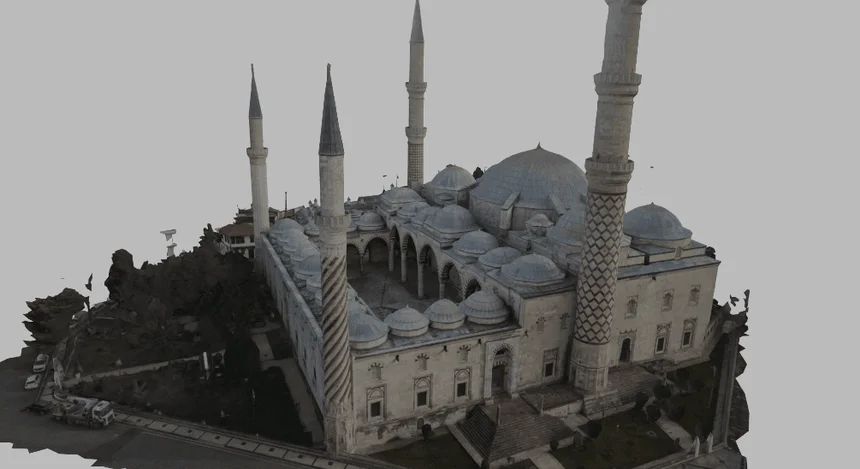
Burmali Mosque and Historical Peykler Madrasa
- Price
- Free
- Type
- 3D Models
- Dimensions
- 3D
- Setting
- Medieval, Asian
An interactive 3D model of a mosque and adjacent madrasa complex with a 38-meter minaret, for Ottoman religious or historical scenes.
Explore Burmali Mosque and Historical Peykler Madrasa with an interactive 3D model on FUNES.WORLD. At dawn, when the call to prayer spirals down the 38-meter minaret of Üç Şerefeli Mosque like a celestial corkscrew, its shadow carves a 15th-century equation into Edirne’s soil: three balconies × four domes = the Ottoman formula for heaven’s calculus. Built between 1438–1447 by Sultan Murad II, this mosque-madrasa complex is not merely architecture—it’s a stone thesis on the symbiosis of knowledge and devotion, where the first Ottoman three-balconied minaret pierces the sky while the adjacent Peykler Medresei whispers algebra to its foundations. Run your palm along the minaret’s helical brickwork—each twist calibrated to mimic a dervish’s whirling path toward enlightenment. The red bricks, fired with Thracian clay and iron oxide, still radiate heat absorbed from 584 summers. During a 2018 thermal scan, restorers discovered voids within the structure: intentional gaps filled with sheep’s wool to dampen wind harmonics, allowing the muezzin’s voice to ascend unsullied. Atop the third şerefe (balcony), iron clamps installed after the 1752 earthquake bear Genoese smiths’ marks—a secret contract between rival empires to stabilize the skyline. Beneath the central dome’s 24-meter span, geometry becomes liturgy. The four auxiliary domes aren’t mere supports—their centers form a perfect square intersecting the mihrab axis, creating an invisible cube symbolizing earthly tethers. Look closer: the İznik tiles’ floral motifs encode Fibonacci sequences, while the stained-glass windows’ cobalt blue matches dye samples from Timurid-era Samarkand manuscripts. In 2016, spectral imaging revealed erased frescoes beneath plaster—Byzantine angels holding compasses, their wings clipped during Murad II’s purges of syncretic art. The adjacent Peykler Medresei, its courtyard shadowed by centuries-old plane trees, offers a quieter revelation. Here, Ottoman polymaths once debated Avicenna while…
Available on
- Funes Free