GetAssetPack

Sanyou Cave

Sanyou Cave
Price
Free
Type
3D Models
Dimensions
3D
Setting
Nature, Asian

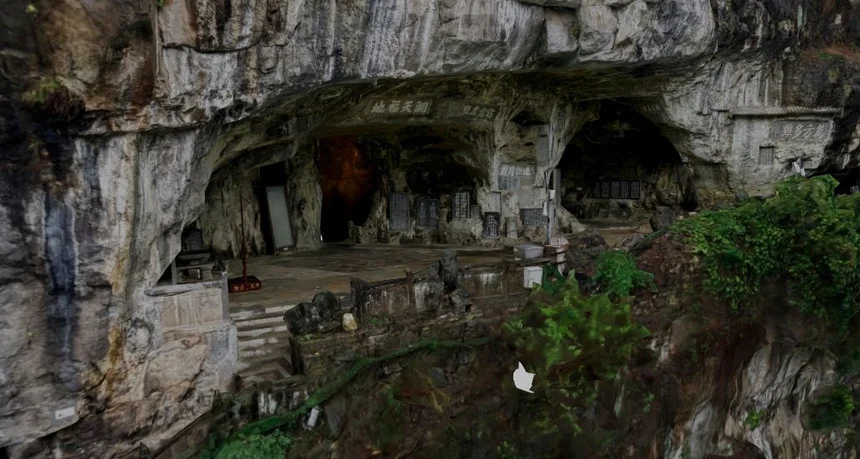
An interactive 3D model of Sanyou Cave, a limestone grotto with front and rear chambers, for cultural or natural landmark scenes.

Explore Sanyou Cave with an interactive 3D model on FUNES.WORLD. On the sheer northern cliff of Xiling Mountain, just seven kilometers northwest of Yichang in Hubei Province, a limestone cavern opens its mouth towards the confluence of the mighty Yangtze River and the placid Xialao Stream. This is Sanyou Cave, the "Cave of Three Travelers," a place where nature's slow artistry and the fleeting brushstrokes of China's greatest literary minds have converged for over a millennium. It is not merely a scenic wonder but a hallowed hall of Chinese culture, a national treasure designated as a National Key Cultural Relics Protection Unit in 2006. The cave itself is a geological marvel, its origins tracing back to the Cambrian period, some 500-600 million years ago. Formed by ancient groundwater dissolving the rock, it is a spacious grotto measuring approximately 30 meters deep, 23 meters wide, and 9 meters high. Its entrance is broad, shaped like an overturned lotus leaf. Inside, the space is divided into a front and a rear chamber by three stalactite pillars. The front chamber is bright and open, its stone walls serving as a sprawling, centuries-old guestbook. The rear chamber is deep and mysterious; its ceiling has a circular hole, and legend says that throwing a stone through it produces a sound like a great bell from the heavens, while the stone's landing echoes like a drum from the earth—a phenomenon known as "Heavenly Bell and Earthly Drum." But the cave's soul was forged by two legendary gatherings. The first, known as the "First Three Travels", occurred in 819 AD during the Tang Dynasty. The famed poet Bai Juyi, his brother Bai Xingjian, and their friend, the poet Yuan Zhen, met serendipitously in Yiling. They explored the cave together, each composing a poem to commemorate their journey. Bai Juyi penned the "Preface to the Three Travels", which was inscribed on the cave wall, giving the cavern its enduring name. Over a century later, in the Northern Song Dynasty…

Available on

Search by image

Upload a reference to find previews with similar colors, contrast, and detail.

Sanyou Cave

Sanyou Cave
FunesFree
3D Models
License not indexed
  • i Check the terms on the original listing.
Show full terms

Explore Sanyou Cave with an interactive 3D model on FUNES.WORLD. On the sheer northern cliff of Xiling Mountain, just seven kilometers northwest of Yichang in Hubei Province, a limestone cavern opens its mouth towards the confluence of the mighty Yangtze River and the placid Xialao Stream. This is Sanyou Cave, the "Cave of Three Travelers," a place where nature's slow artistry and the fleeting brushstrokes of China's greatest literary minds have converged for over a millennium. It is not merely a scenic wonder but a hallowed hall of Chinese culture, a national treasure designated as a National Key Cultural Relics Protection Unit in 2006. The cave itself is a geological marvel, its origins tracing back to the Cambrian period, some 500-600 million years ago. Formed by ancient groundwater dissolving the rock, it is a spacious grotto measuring approximately 30 meters deep, 23 meters wide, and 9 meters high. Its entrance is broad, shaped like an overturned lotus leaf. Inside, the space is divided into a front and a rear chamber by three stalactite pillars. The front chamber is bright and open, its stone walls serving as a sprawling, centuries-old guestbook. The rear chamber is deep and mysterious; its ceiling has a circular hole, and legend says that throwing a stone through it produces a sound like a great bell from the heavens, while the stone's landing echoes like a drum from the earth—a phenomenon known as "Heavenly Bell and Earthly Drum." But the cave's soul was forged by two legendary gatherings. The first, known as the "First Three Travels", occurred in 819 AD during the Tang Dynasty. The famed poet Bai Juyi, his brother Bai Xingjian, and their friend, the poet Yuan Zhen, met serendipitously in Yiling. They explored the cave together, each composing a poem to commemorate their journey. Bai Juyi penned the "Preface to the Three Travels", which was inscribed on the cave wall, giving the cavern its enduring name. Over a century later, in the Northern Song Dynasty, literary history repeated itself. The father-and-sons trio of Su Xun, Su Shi (Su Dongpo), and Su Zhe also visited the cave, each leaving a poem on its walls. Their pilgrimage became known as the "Later Three Travels" . These visits inaugurated a tradition that turned the cave into a living library of Chinese calligraphy and literature. Beyond the poems of its famous namesakes, the cave and its surroundings preserve over 40 cliffside inscriptions and stone tablets from various dynasties. These incl

An interactive 3D model of Sanyou Cave, a limestone grotto with front and rear chambers, for cultural or natural landmark scenes.

View original listing