GetAssetPack

Castle of Fleckenstein

Castle of Fleckenstein
Price
Free
Type
3D Models
Dimensions
3D
Setting
Medieval

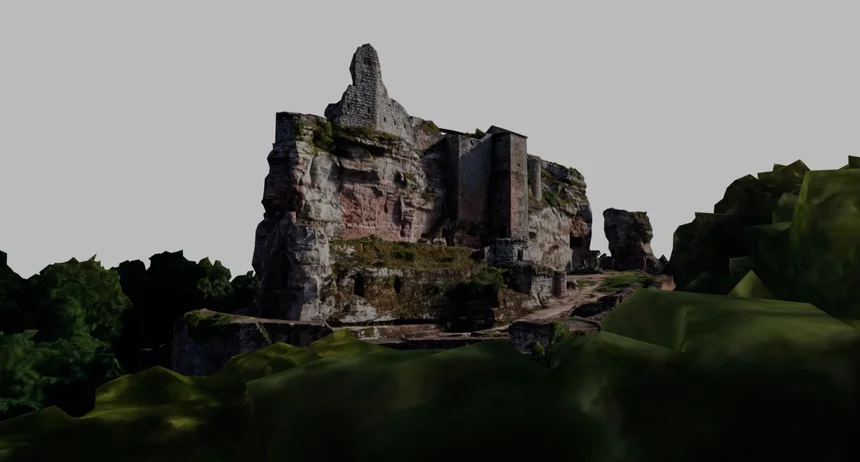
An interactive 3D model of a medieval rock castle carved into a sandstone ridge, with a four-level labyrinth of rooms and defenses.

Explore Castle of Fleckenstein with an interactive 3D model on FUNES.WORLD. Every winter solstice, the low sun arrows through a specific, ruined window of the Castle of Fleckenstein, striking a precise groove carved into the living rock floor. It is a moment of perfect, ancient alignment. For over 800 years, this sandstone outcrop in the Northern Vosges Mountains has not simply held a castle; it is the castle. It is a Felsenburg—a rock castle—a defiant fusion of human ambition and geological permanence that was besieged countless times but never taken by force, until the day its conquerors decided it must not stand at all. Our story begins not with a foundation stone, but with the rock itself. In the mid-12th century, the Fleckenstein family—unfree knights in service to the Holy Roman Emperor—saw not a mere 100-meter-long sandstone ridge, but a natural fortress. Their genius was one of subtraction. They did not just build upon the rock; they carved into its very heart. With chisels striking at the "sweet spot" for weary arms, they hollowed out a vertical labyrinth across four levels: staircases spiraling upwards, cisterns holding precious rainwater, and rooms breathing the cool, damp air of the earth. The rock was both shield and skeleton. For 400 years, the Fleckenstein dynasty grew in power from this impregnable heart. The Castle of Fleckenstein’s strategic position on the border between Alsace and the Palatinate made it a keystone of regional control. Its defenses were a masterpiece of medieval pragmatism. The Lower Castle (Unterburg) bustled with the life of a garrison—the scent of hay from the stables, the ring of hammers in workshops, all protected by a fortified gate. High above, the Upper Castle (Oberburg) housed the lord’s residence and the knights’ hall, where the air was clearer and the power palpable. And at the very summit, hewn from the rock pinnacle itself, stood the keep. From this ultimate refuge, a sentinel’s gaze could sweep the forested valleys…

Available on

Search by image

Upload a reference to find previews with similar colors, contrast, and detail.

Castle of Fleckenstein

Castle of Fleckenstein
FunesFree
3D Models
License not indexed
  • i Check the terms on the original listing.
Show full terms

Explore Castle of Fleckenstein with an interactive 3D model on FUNES.WORLD. Every winter solstice, the low sun arrows through a specific, ruined window of the Castle of Fleckenstein, striking a precise groove carved into the living rock floor. It is a moment of perfect, ancient alignment. For over 800 years, this sandstone outcrop in the Northern Vosges Mountains has not simply held a castle; it is the castle. It is a Felsenburg—a rock castle—a defiant fusion of human ambition and geological permanence that was besieged countless times but never taken by force, until the day its conquerors decided it must not stand at all. Our story begins not with a foundation stone, but with the rock itself. In the mid-12th century, the Fleckenstein family—unfree knights in service to the Holy Roman Emperor—saw not a mere 100-meter-long sandstone ridge, but a natural fortress. Their genius was one of subtraction. They did not just build upon the rock; they carved into its very heart. With chisels striking at the "sweet spot" for weary arms, they hollowed out a vertical labyrinth across four levels: staircases spiraling upwards, cisterns holding precious rainwater, and rooms breathing the cool, damp air of the earth. The rock was both shield and skeleton. For 400 years, the Fleckenstein dynasty grew in power from this impregnable heart. The Castle of Fleckenstein’s strategic position on the border between Alsace and the Palatinate made it a keystone of regional control. Its defenses were a masterpiece of medieval pragmatism. The Lower Castle (Unterburg) bustled with the life of a garrison—the scent of hay from the stables, the ring of hammers in workshops, all protected by a fortified gate. High above, the Upper Castle (Oberburg) housed the lord’s residence and the knights’ hall, where the air was clearer and the power palpable. And at the very summit, hewn from the rock pinnacle itself, stood the keep. From this ultimate refuge, a sentinel’s gaze could sweep the forested valleys, a panoramic vigilance that for centuries meant safety. Then, in the 16th century, a new sound echoed through the stone halls of the Castle of Fleckenstein: not the grim industry of war, but the confident chatter of Renaissance refinement. The family, now one of the most influential in the Northern Vosges, decided their formidable fortress should also be a home. They carved larger windows to welcome light, allowing vistas of the surrounding beauty to compete with the strategic views of approachin

An interactive 3D model of a medieval rock castle carved into a sandstone ridge, with a four-level labyrinth of rooms and defenses.

View original listing