10 themes · 23 terrains that meet at any corner · 8 settlement cultures · 77 landmarks · works in any engine, with Godot 4 and Unity 6 projects included. Everything that moves loops on one shared 2.88-second clock.
Play Hollow Legacy on Wavedash, a JRPG where you wake up as a slime, and its world map is drawn with this atlas.
Show full description...
Overworld Atlas is a 32 px square-grid tileset for strategy maps, RPG travel maps and 4X campaign screens. Paint terrain into a grid and the coasts, forests, rivers and borders draw themselves. Add towns, landmarks and units and the map starts to breathe: water ripples, lava glows, chimneys smoke, mills turn, flags fly and boats rock at their moorings. Open any screenshot to watch it move.
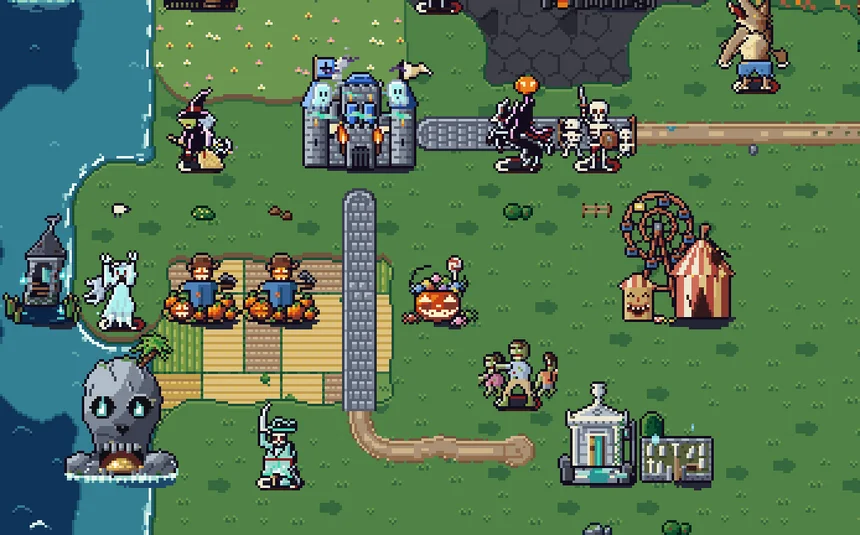
New: the Haunting, a free Halloween update
12 haunted landmarks spread through every theme: a haunted manor, a pumpkin patch, a mausoleum, a drowned belfry, a frost barrow, a candy cottage, a ghost ship, a skull rock, drowned graves, a vampire castle, a haunted carnival and a cursed tomb. There is a Halloween pickup too: a candy pail brimming with sweets.
10 new monsters walk the roads between them: a skeleton horde, a zombie horde, a mummy, a lich, a werewolf, a headless horseman, a witch, a banshee, a vampire and a ghost pirate. And any town of any culture can now be haunted: ghosts wheel over its rooftops while the town carries on beneath them.
Every one moves on the same clock as the rest of the map, and the update is free for everyone who owns the pack.
It moves. All of it, together.
Water, shore foam, rivers, lava, chimney smoke, mills, flags, moored boats, wisps and portals: every animated tile has 4 to 8 frames, and every loop divides one 2.88-second cycle. Drive the whole map from one timer and nothing drifts out of step; record 2.88 seconds of any stretch and the clip loops without a seam. A whale surfaces and dives, dolphins leap in the shallows, deer graze, herons hunt and fire bats flit over the ash, each on its own ground. Prefer stills? The first frame of every loop is a complete static tileset.
Ten themes, one continuous world
Shown at actual size. Every theme shares one palette and one set of edge rules, so any of them can sit beside any other.
- Core: open sea, coast, roads, borders, fog, settlements and units; campfire, cave, dungeon, graveyard, ruined tower, statue and 14 more.
- Wasteland: dust flats, ash frost, reclaimed asphalt, blast craters, nuclear waste and dead cities; bunker, radio mast, crashed plane, reactor, waystation and haunted carnival.
- Temperate: green grassland, flower meadows, farmland, broadleaf and seasonal forests; windmill, watermill, watchtower, standing stones, ruined castle, monastery and 2 more.
- Wetlands: reedy marshes and dark peat bogs; witch's hut and drowned belfry.
- Arid: golden deserts, savanna, red badlands, dunes, mesas and cacti; oasis, mine, desert temple, caravan camp, titan bones, headframe and 7 more.
- Frozen: snowfields, tundra, ice sheets, taiga and snow-capped peaks; ice cave, frozen titan and frost barrow.
- Tropical: turquoise lagoons, white beaches, jungle, palms, reefs and mangroves; shipwreck, lighthouse, jungle temple, web nest and skull rock.
- Volcanic: black basalt, ash plains, lava flows and cinder cones; volcano, steam vents, fire forge, dragon lair and vampire castle.
- Fantasy: corrupted blight, crystal fields, giant mushrooms, fey forests and pools of living slime; shrine, wizard tower, portal, great tree, fairy ring, sky island and 2 more.
- Eldritch: drowned cyclopean ruins, black abyssal water, tentacle fields, ichor pools and monoliths that are the wrong shape; drowned idol, watching eye, elder gate, cult circle, void rift, sunken spire and drowned graves.
Temperate lands and kingdom towns have a winter: snow on the fields, woods and roofs, and on landmarks and nordic halls.
Any terrain borders any other
Each display tile reads the four cells that meet at its corner, so two-, three- and four-way junctions all come from one rule: 16 corner masks per terrain, and no transition tiles to paint by hand. Forests, hills, reefs and dunes merge across cells the same way and rivers meander, fork and run down to the sea. Roads in five styles: dirt tracks, cobbled roads, cracked highways, raised causeways over the marsh, and railways with level crossings and iron bridges. Hedgerows and dry-stone walls divide farmland into fields, with a gate wherever a road passes.
Eight cultures, from hamlet to capital
Salvage towns, medieval kingdoms, desert kasbahs, nordic longhouses, tropical stilt villages, fey tree halls, drowned cult towns and frontier rail towns. Each culture has three town sizes, a capital, a fortress, an outpost, war and raider camps and razed ruins, and a coastal town builds its own harbour on its water side. Bridges come in each culture's own style. Capitals and great harbour towns build ships: a hull on the slipway and a working crane, in every culture.
Everything a player owns takes 8 team colours, plus hostile and neutral, and a colour-blind palette switches the team colours to hues that stay apart, on the same sprites.
Landmarks worth walking to
77 landmarks, each native to a theme and every one of them animated: caves, dungeons, temples, ruined castles, wizard towers, dragon lairs, inns and trading posts, bunkers, crashed planes, sky islands and sunken spires. Around them the working land: 15 improvements (farms, orchards, lumber camps, quarries, fisheries, mines and oil derricks), 14 resources and 7 kinds of pickup.
Contested ground: fortresses and outposts hold the borders, war camps gather beside them, towns burn, towns are haunted and fall to ruin, and weather settles over any stretch of the map you mark: rain, snow, sandstorms, ashfall, cloud shadow and storm cells. Walls open a gate wherever a road passes, plateaus climb by cliff stairs and rivers fall from their edges into plunge pools.
A strategy layer in the box
Units in two styles, team borders, three-state fog of war whose edge drifts, move, attack and path overlays, and map markers for quests, merchants and danger.
14 unit types, boats and ships among them, and 18 wild monsters: a wolf pack, a sand wyrm, a frost troll, a bog horror, a cinder brute, a mutant, a treant, a tentacle horror, a skeleton horde, a zombie horde, a mummy, a lich, a werewolf, a headless horseman, a witch, a banshee, a vampire and a ghost pirate.
Make it look like a map
A compass rose, cartouches, a scale bar, a wind head, a sea serpent, a map frame, place-name ribbons and dotted travel routes, so a game map can look like one.
Works in any engine
The Godot and Unity projects are a head start, not a requirement. The art is PNG and the data is JSON, so the map draws in GameMaker, Phaser, LÖVE, MonoGame, Bevy, Pygame, raylib or an engine of your own: anything that can draw part of an image. The quick start is under Reference, below.
- The art: 17 atlas pages at 1x and 2x, with atlas.json naming every sprite's page, rect and pivot and every animation's frames and timing. The source tileset and every animation frame also come as separate PNGs, for engines that pack their own atlases.
- The edges, already worked out: the resolver reads a map file and returns its draw list, every sprite with its layer and pixel position, in the order to draw it. It comes in Python, using only the standard library, and in plain C# that needs nothing from Unity, so it also runs in MonoGame, FNA, Stride or on a .NET server. Or run it once as you build your game and save the list as JSON for any engine to read.
- A working reference: the Godot and Unity renderers come with every purchase and show how fog, team colours and animation phases are drawn.
Ready to run in Godot and Unity
- Open the Godot 4 or Unity 6 project and press Play. The demo scenes open the example maps, and fog and the colour-blind palette are one switch each.
- Paint a map: both projects ship a painter for every terrain, feature and landmark, grouped by theme, and every edge redraws as you go.
- Run a game on it: your game can repaint the map while it runs, and only the cells an edit reaches redraw. The animation clock can be pinned for turns, replays and captures.
- Ship it: a map is one small JSON file, checked by the included JSON Schema and read identically in Python, C# and GDScript, so your editor, your server and your game all see the same map.
DownloadWhat it is
overworld-atlas-art.zipArt and data — 10 themes, 23,149 atlas sprites, PNG + JSON, Python resolver
overworld-atlas-godot.zipGodot 4 project — map renderer, painter and demo scenes
overworld-atlas-unity.zipUnity 6 project — map renderer, painter and demo scenes
Requirements
- Godot 4.7 or newer. The project is set up for crisp pixels: nearest filtering and pixel snap.
- Unity 6 (6000.0): the project opens as it ships, and its folder drops into a new URP project.
- Any other engine: anything that can draw part of a PNG and read JSON. The resolver comes in Python and in C#.
Good to know
- Square grid only; not hex or isometric.
- 32 px tiles, drawn for whole-number zoom (1x, 2x and 3x) with nearest-neighbour filtering.
- World-map scale: towns and landmarks are one to two cells, not interiors.
- Maps up to 128 × 96 cells.
- Maps use the pack's own JSON format; Tiled and LDtk export are not included.
Licence
Use it in commercial and non-commercial games, in as many titles as you like, and change it however your project needs. Credit is appreciated, not required. Ship it inside your game; just don't resell or redistribute the pack itself, changed or unchanged.
Everything on this page is one purchase: every theme, the Godot and Unity projects, and the free updates that follow.
Reference
What's in each download
FileContents
overworld-atlas-art.zipPNG atlas pages at 1x and 2x, atlas.json, palette.json, GPL and HEX palettes, every animation frame as its own PNG, the source tileset with tileset.json, the Python resolver, the map JSON Schema and example maps, a plate for every theme, README, licence and credits
overworld-atlas-godot.zipAddon (map node, resolver, atlas loader, painter), demo scenes and example maps
overworld-atlas-unity.zipRuntime map renderer, resolver, sliced atlas, editor painter, demo scenes and example maps
Everything in the box, theme by theme
ThemeTerrainsFeaturesLandmarksPickups
Core1 + the open sea—205
Wasteland4861
Temperate348—
Wetlands122—
Arid3413—
Frozen333—
Tropical345—
Volcanic225—
Fantasy148—
Eldritch2371
Plus 8 settlement cultures, 14 unit types in two styles, 18 wild monsters, 14 resources, 15 improvements, 6 kinds of weather, 21 overlay sprites, 10 map markers and 21 cartographic pieces.
Animation, frame by frame
Each animation in atlas.json lists its frames, their durations and a phase (shared by the whole map and offset per cell, so neighbouring trees do not sway in lockstep). 2,057 animated sprites; every cycle is 480, 720, 960, 1,440 and 2,880 ms long and every frame lasts a whole number of 10 ms, so one timer drives the whole map and the Godot and Unity renderers already play it:
t = elapsed_ms % 2880 # one clock for every tile on the map
Terrain frames change colour, never outline, so an animated coast still lines up with the still tiles around it.
How the edges fit
Terrain, shore, feature and fog edges use four-corner masks. Bit order is NW=1, NE=2, SW=4, SE=8, and a sprite's name carries its mask in hex, mask_00 to mask_0f. Higher terrains draw over lower ones where they meet.
mask = (NW?1:0) | (NE?2:0) | (SW?4:0) | (SE?8:0) Layers and draw order
Cells are 32×32 px. Layers draw in this order: water and terrain, field boundaries, plateaus, rivers, walls, features, scenery, roads and bridges, improvements, resources, landmarks, borders, harbours, settlements, units, weather, fog and map decoration. Tall features and landmarks rise from the cell that owns them.
The map format
{ "schema": "wasteland-overworld/map@0.4", "seed": 7, "width": 3, "height": 2, "terrain": { "legend": { "g": "grassland", "l": "lagoon" }, "rows": [ "ggl", "gll" ] }, "settlements": [ { "at": [0, 1], "team": 0, "style": "tropical", "size": 9, "capital": true } ] }
That is a complete map: a capital on a lagoon shore, with the harbour it builds on its water side. Rivers, roads, landmarks, units, owners, fog and weather are further lists and grids beside it. Python, C# and GDScript read the same file and produce the same draw list, byte for byte.
Teams and colour-blind mode
8 player teams plus hostile and neutral, each in a standard and a colour-blind palette, keyed by mode and team in atlas.json.
Fog
Fog states are visible, explored and unexplored. Resources you have seen stay drawn under explored fog; units, settlements, camps, landmarks and other live objects stay hidden outside visible cells, and unexplored fog hides everything beneath it. Explored and unexplored edges seal against terrain.
Godot 4 quick start
- Unzip the Godot project and open it in Godot 4.7 or newer.
- Run demo/demo.tscn, or demo/paint_demo.tscn to paint.
- Copy addons/overworld_atlas into your project, add a OverworldAtlasMap node and point it at a map file.
var map := OverworldAtlasMap.new() add_child(map) map.load_map_file("res://maps/world.map.json")
MemberWhat it does
map_json_path, load_map_file(path), set_map_data(data)the map file to draw, or its data
show_fog, palette_modefog on or off; the standard or colour-blind team palette
animate, time_ms_overridethe animation clock, or a pinned time for turns, replays and captures
set_terrain(x, y, id), set_feature(x, y, id), set_poi(x, y, id)edit while the game runs; only the cells an edit reaches redraw
terrain_at(x, y), feature_at(x, y), map_data()read the map back
validate()every problem in the loaded map, with its cell
season_overrideswitch seasons at runtime without rebuilding the map; empty keeps the map's own
DualGridPainter, painted(brush, cell)the painter node and the signal it sends per cell
Unity 6 quick start
- Unzip the Unity project and open it in Unity 6.
- Open Demo.unity or PaintDemo.unity and press Play.
- Copy Assets/OverworldAtlas with its .meta files into your project, add the OverworldAtlasMap component to a GameObject and assign a map, or paint one with Overworld Atlas › Dual Grid Painter.
Starting from the 2D URP template? If its 2D Pixel Perfect package will not compile, swap the 2D feature set for the 2D Sprite and 2D Tilemap packages.
MemberWhat it does
mapJson, tilesetJson, atlasJsonthe map to draw and the pack's data
ReloadAndRedraw()load the map again and draw it
SetTerrain(x, y, id), SetFeature(x, y, id), SetLandmark(x, y, id)edit while the game runs
SetFogVisible(on), SetPaletteMode(mode)fog on or off; the standard or colour-blind team palette
playAnimation, SetAnimationTimeMs(ms)the animation clock, or a pinned time
Placementsevery sprite the map placed, with its layer, cell and pixel
seasonOverrideswitch seasons at runtime without rebuilding the map; empty keeps the map's own
Other engines quick start
- Unzip the art download. Load the pages in atlas/ at the scale you draw at, and read atlas/atlas.json.
- Resolve a map into its draw list. From the art download's folder:
import json, sys sys.path.insert(0, "resolver") import resolver ops = resolver.resolve_map(resolver.load_map_file("maps/showcase.map.json"), "tileset")["draw_ops"] with open("showcase.draw.json", "w") as f: json.dump(ops, f) # one op per sprite, in draw order
Draw the ops in list order. Each one names a sprite and the pixel where its top-left goes: draw that sprite's rect from its page there. An op with a team draws the sprite keyed <sprite>#standard/<team>, or #colorblind/ for the colour-blind palette. An animated sprite steps through the frames atlas.json lists for it, on the one 2,880 ms clock. With fog on, hide what the Fog section says each state hides.
In C#, the same resolver is Assets/OverworldAtlas/Runtime/Vendored/DualGridResolver.cs and DualGridMapJson.cs beside it, in the Unity download. To change the map while the game runs, resolve it again.
Atlas pages and sprite names
17 atlas pages at 1x and 2x, 23,149 sprites, grouped by theme. Frames keep their base id: <base>@f<k>. Team sprites add a mode and team key in atlas.json.
PageSprites
core2,576
core-21,961
core-31,487
temperate2,003
temperate-2104
wetland1,194
arid2,063
arid-2386
frozen1,953
frozen-2295
tropical1,835
tropical-2703
volcanic1,469
fantasy1,864
fantasy-2368
eldritch1,892
eldritch-2996
Updates
Updates to this pack are free for everyone who owns it. Each one is announced in a devlog on this page.
Licence in full
- Use in commercial and non-commercial projects, in unlimited titles, with no revenue cap.
- Modify the art and code freely.
- Attribution is appreciated, not required.
- Do not resell or redistribute the pack itself, modified or unmodified, as an asset pack, template or asset library, including inside a larger collection.
- Shipping it inside a game, application, video or other finished work is exactly what it is for.
Original art and sample projects © Out of Tokens Studio; LICENCE.txt and CREDITS.txt are in every download. The store images are lettered in Silkscreen and Tiny5, both under the SIL Open Font License 1.1; neither font is part of the downloads.
 GetAssetPack