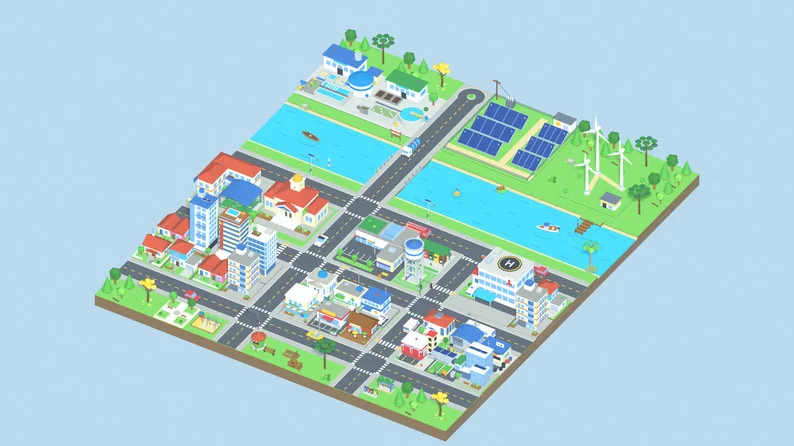
Low Poly City Kit (Kit Cidade Low Poly) is a free, public domain (CC0 1.0) pack of 129 low poly 3D models in glTF/GLB for building cities in games and visualizations: houses, shops, public services, water and sanitation, renewable energy, waste and recycling, parks, modular road and terrain tiles (2 × 2), vehicles, street furniture, Brazilian native trees (yellow ipê, araucaria, buriti palm) and riverside props. Classic flat-color low poly look, no textures, at most 1,500 triangles per model.
Show full description...
Made for city builders, tycoon and simulation games, educational games, isometric game prototypes, game jams and architectural mockups. Everything snaps to one grid: 1 lot = 2 × 2 units.
What's inside
129 models in 14 categories. Building sizes are given in lots (1×1, 2×2, 3×3, 4×4).
- Residential (5): small house, two-story house, semi-detached houses, residential high-rise, apartment building.
- Commercial (8): bank branch, office building, hotel, corner shop, neighborhood grocery store, electric car charging station, restaurant, shopping mall (2×2).
- Public services (12): public library, fire station, research center, technology center, school, hospital, historic monument, museum (3×3), police station, health clinic, city hall, university (3×3).
- Industry (4): factory (2×2), warehouse, car repair shop, port (2×2, on water).
- Water and sanitation (16): underground dam, water pump station, elevated water tower, water loss control center, water research center, filtration station, monitoring station, water treatment plant, sewage treatment plant, rain garden, floating garden (on water), water quality monitor, artesian well, water reservoir, desalination plant, water reuse plant.
- Energy (11): biodigester, hydroelectric dam (on water), wind farm, power line pole, thermal power plant, biomass power plant, sugarcane ethanol and bioenergy mill, coal power plant, tidal power plant (on water), nuclear power plant (4×4), solar farm.
- Waste and recycling (4): sanitary landfill, recycling cooperative, composting yard, recycling drop-off point.
- Parks (5): eco park, green wall, tourist park (4×4), linear park, green roof building.
- Roads, modular 2 × 2 tiles (12): straight asphalt road, curve, T-junction, crossroads, straight road with crosswalk, dead end with turnaround, sidewalk, parking lot, concrete bridge (replaces a water tile), town square, straight and curved dirt road.
- Terrain, modular 2 × 2 tiles (9): water, sand, forest, grass, straight riverbank, riverbank corner, hill, terrain ramp, packed dirt.
- Vehicles (10): ambulance, bicycle, box truck, fire truck, garbage truck, water tanker truck, red hatchback car, electric car, city bus, taxi.
- Street furniture (20): park bench, rain barrel, public drinking fountain, bike rack, wooden fence section, precast rainwater cistern, fire hydrant, trash bin, recycling bins, Brazilian public phone booth (orelhão), playground, riverside educational sign, stop sign, bus stop with green roof, street light, solar street light, park kiosk, traffic light, pedestrian traffic light, concrete planter.
- Vegetation (7): araucaria (Paraná pine), shrub cluster, buriti palm, two-bay compost bin, community vegetable garden bed, yellow ipê, riverside rock cluster.
- Riverside (6): small motor fishing boat, river monitoring buoy, wooden fishing canoe, capybara, great egret, short wooden pier.
Technical details
- Format: binary glTF 2.0 (.glb), one file per model, plus models/catalogo.json with triangles, file size and a description for every model.
- Triangle budget: at most 1,500 triangles per model (from 24 for a grass tile to 1,488 for the nuclear power plant).
- Materials: one PBR material per color (base color only, roughness 0.85). No textures, no UVs. Convert material colors into vertex colors to batch a whole neighborhood into a handful of draw calls.
- Scale and grid: 1 lot = 2 × 2 units. Buildings take N × N lots; road and terrain tiles cover exactly x, z in [-1, 1] and snap side by side, rotating in 90° steps around Y. Vehicles, props and street furniture use a "toy" scale that matches the lots.
- Axes: Y up, model front facing -Z (glTF convention).
- Road and terrain measurements: terrain block from y -0.3 to 0 (grass top at 0); road tiles include the block below and replace the terrain tile; asphalt 1.3 wide with a dashed yellow center line; sidewalk top at y 0.07, curb top at 0.075; water surface at y -0.12; hill top at y 0.6. Connection rules for every tile are in the README, and src/cena_cidade.py builds a sample neighborhood.
- Animatable parts: objects named pas_N (rotors, spin around the hub axis) and gira_N (spin upright) are kept separate from the body with the pivot in place, for example in the wind farm.
- File size: at most 150 KB per model.
- Engines: opens directly in Godot 4, three.js (GLTFLoader), Babylon.js, Blender and Unreal Engine 5 (Interchange). In Unity, use the glTFast package.
- Editable source: every model is a short Python script for Blender 4.5 LTS (src/<category>/<id>.py) built from shared helpers and one color palette in src/lib.py. You can change a script and rebuild one model, one category or the whole kit.
- Names: file and folder names are in Portuguese (for example residencial/casa_simples.glb = small house). The English name of every file is in tools/nomes_en.json and in the README catalog.
Great for
- City builders, tycoon and simulation games
- Educational games about water, sanitation, energy and waste
- Isometric game prototypes and game jams
- Architectural mockups and visualizations
- Mobile and web projects (no textures, small files)
License
Public domain (CC0 1.0). Use it however you like, in personal, educational or commercial projects; modify and redistribute it. Commercial use is allowed, no permission or payment needed. Attribution is optional (citation data is in CITATION.cff). No warranty.
Files
- kit-cidade-lowpoly-main.zip: the full repository: all 129 .glb models and catalogo.json, preview images, the Blender Python scripts that generate every model, tools and docs (README in English and Portuguese, LICENSE, CITATION.cff).
Source and updates
The kit lives on GitHub, where you can follow updates and open an issue to request a model: github.com/kayquer/kit-cidade-lowpoly
It was born from the original models of the educational game Guardião da Água (Water Guardian), a product of Cláudia Dias Roxinol's master's research (Unesp, Presidente Prudente, Brazil), developed with Kayque Rotondo. Made with Blender, with Claude (Anthropic) as an assistant. No third-party models are included.
The download is free. A donation is optional and helps fund more free packs.
Em português
O Kit Cidade Low Poly é um pacote gratuito e em domínio público (CC0 1.0) com 129 modelos 3D low poly em glTF/GLB para montar cidades em jogos e visualizações: casas, comércio, serviços públicos, água e saneamento, energia renovável, resíduos, parques, ruas e terreno modulares (tiles 2 × 2), veículos, mobiliário urbano, árvores nativas brasileiras (ipê-amarelo, araucária, buriti) e beira de rio. Cores chapadas, sem texturas, até 1.500 triângulos por modelo.
O que vem no pacote (129 modelos, 14 categorias)
- Residencial (5): casa simples, sobrado, casas geminadas, prédio alto, prédio de apartamentos.
- Comércio (8): banco, escritório, hotel, loja de esquina, mercado, posto de recarga de carro elétrico, restaurante, shopping (2×2).
- Serviços públicos (12): biblioteca, bombeiros, centro de pesquisa, centro de tecnologia, escola, hospital, monumento histórico, museu (3×3), polícia, posto de saúde, prefeitura, universidade (3×3).
- Indústria (4): fábrica, galpão, oficina, porto (sobre a água).
- Água e saneamento (16): barragem subterrânea, bomba d'água, caixa d'água elevada, centro de controle de perdas, centro de pesquisa da água, estação de filtragem, estação de monitoramento, ETA, ETE, jardim de chuva, jardim flutuante, monitor de qualidade da água, poço artesiano, reservatório, usina de dessalinização, usina de reúso de água.
- Energia (11): biodigestor, hidrelétrica, parque eólico, poste de energia, termelétrica, usina de biomassa, usina de cana (etanol e bioenergia), usina a carvão, usina maremotriz, usina nuclear (4×4), usina solar.
- Resíduos (4): aterro sanitário, cooperativa de reciclagem, pátio de compostagem, ponto de coleta.
- Parques (5): ecoparque, parede verde, parque turístico (4×4), parque linear, prédio com telhado verde.
- Ruas (12) e terreno (9), peças de 2 × 2: reta, curva, T, cruzamento, faixa de pedestre, rua sem saída com retorno, calçada, estacionamento, ponte, praça, estradas de terra; água, areia, mata, grama, margens de rio, morro, rampa, terra batida.
- Veículos (10): ambulância, bicicleta, caminhão baú, caminhão de bombeiros, caminhão de lixo, caminhão-pipa, carro, carro elétrico, ônibus, táxi.
- Mobiliário urbano (20): banco de praça, barril de chuva, bebedouro, bicicletário, cerca de madeira, cisterna, hidrante, lixeira, lixeira seletiva, orelhão, parquinho, placa educativa, placa de pare, ponto de ônibus, poste de luz, poste solar, quiosque, semáforos, vaso de planta.
- Vegetação (7) e beira-rio (6): araucária, arbustos, buriti, composteira, horta, ipê-amarelo, pedras; barco de pesca, boia de monitoramento, canoa, capivara, garça, trapiche.
Detalhes técnicos
- glTF binário (.glb), Y para cima, frente para -Z.
- Até 1.500 triângulos e 150 KB por modelo.
- Um material PBR por cor (só cor base, rugosidade 0,85), sem texturas nem UVs; converta em cor de vértice para juntar tudo em poucas draw calls.
- 1 lote = 2 × 2 unidades; prédios ocupam N × N lotes; ruas e terreno se encaixam numa grade de 2 unidades, girando de 90° em 90°.
- Partes animáveis separadas, com pivô no lugar: pas_N (rotores) e gira_N (giram em pé).
- Funciona em Godot 4, three.js, Babylon.js, Blender e Unreal Engine 5; no Unity, use o glTFast.
- Cada modelo é um script Python para Blender 4.5 LTS: dá para alterar e gerar de novo.
Licença
Domínio público (CC0 1.0). Use como quiser, em projetos pessoais, educativos ou comerciais; modifique e redistribua. Uso comercial liberado, sem pedir permissão nem pagar. Atribuição é opcional (os dados de citação estão em CITATION.cff). Sem garantia.
Código e atualizações: github.com/kayquer/kit-cidade-lowpoly. Nasceu dos modelos do jogo educativo Guardião da Água, produto da pesquisa de mestrado de Cláudia Dias Roxinol (Unesp, Presidente Prudente), desenvolvido com Kayque Rotondo.
O download é gratuito. A doação é opcional e ajuda a financiar mais pacotes livres.
 GetAssetPack