Show full description...
Coriolis is a 100-asset sci-fi space station pixel art pack at 32×32: a 40-tile seamless tileset, 40 inventory icons, 20 machines and 2 animation loops, all on one 31-colour palette. Its tiles are identified by the terrain at their four corners rather than by their edges, which is why they cannot show a seam: measured across all 512 legal four-tile arrangements, the discontinuity where four tiles meet is exactly zero, and every compatible pair joins on pixel-identical columns. The reason edge-matched tilesets tear at those points was named in a 2006 ACM paper, and this pack is built the other way. Everything below is measured from the build log, not estimated — including the 35 faults the build caught and refused to ship.
What you get: 134 files, 82 KB · individual indexed PNGs for every asset · Aseprite-format atlases for icons and tiles · animation frames, strips and GIF previews · coriolis.gpl and coriolis.hex palettes · commercial use, no attribution required · no generative AI was used at any stage.
A station floor assembled by the corner rule alone. Deck, a marked keep-out zone and vacuum are three terrains composited from 19 drawings, not 81. No socket table was written.
What is in the pack?
Why do edge-matched tiles tear where four tiles meet?
How many tiles does a terrain transition really need?
What made the tiles read as plates instead of wallpaper?
How do you stop a tiling floor showing its 32-pixel grid?
What is the difference between a pattern and an element?
What made 18 of the 20 machines readable?
Which animations ship, and why only two?
How is "100 distinct assets" verified rather than claimed?
What does the pack deliberately not do?
Frequently asked questions
What is in the Coriolis sci-fi tileset pack?
Coriolis contains 100 distinct 32×32 pixel art assets for space station, sci-fi and top-down base-building games. The count is verified by the build rather than asserted on this page: the build refuses to write the pack if any two assets share a silhouette, and it found two that did.
Coriolis pack contents, version 1.0.0, August 2026
GroupCountSizesWhat is measured
Sci-fi inventory icons 40 32×32 fill ratio 18–52%, no clipping, every icon carries a non-grey accent
Seamless station tiles 40 32×32 0 seam failures, 0 corner tear across 512 arrangements, edges pixel-identical
Machines and props 20 32×32 to 64×64 fill ratio 18–92%, no empty parts, tonal range 148.5 against a 149.3 reference
Animation loops 2 8 frames each loop closes exactly, palette does not drift across the cycle
Palette 31 — one table across all 100, exported as .gpl and .hex
Archive 134 files 82 KB reproducible: fixed order, fixed timestamp, stable sha256
Why do edge-matched pixel art tiles tear where four tiles meet?
Because two tiles that meet diagonally share no edge at all. Ares Lagae and Philip Dutré named this the corner problem in An alternative for Wang tiles: colored edges versus colored corners (ACM Transactions on Graphics 25(4), 2006). Their sentence is the whole diagnosis: "Wang tiles led to continuity problems near tile corners… Corner tiles do impose restrictions on their diagonal neighbors, and thus are not subject to the corner problem."
An edge-coloured scheme constrains left-to-right and top-to-bottom and says nothing about the diagonal. A corner scheme identifies each tile by the four terrain values at its corners, so a tile and its right-hand neighbour read the same two data corners — one as its right pair, the other as its left pair. There is no socket table to get wrong in the Coriolis tileset, because there is no table.
All 16 corner tiles, each shown among neighbours the family actually permits. The common 3×3 preview — one tile repeated in a grid — is a valid question for only 2 of the 16; for the other 14 it renders an arrangement the family forbids.
How many tiles does a seamless terrain transition really need?
Sixteen for a corner scheme, 47 for a blob set, and six drawings if the art carries no baked light direction — the 16 corner masks fall into 6 equivalence classes under rotation and mirroring. The 47 figure is computed in the Coriolis build by gating the 256 raw 8-bit neighbourhood masks, not copied from a table, because a 47-entry table taken off a web page is a fact nobody on the project can check.
Tileset sizes by autotiling scheme, computed rather than quoted
SchemeTilesDrawings with rotation + mirrorNote
Corner / dual-grid (S-V2) 16 6 used by Coriolis
Wang edge (S-E2) 16 — subject to the corner problem
Blob (S-V2E2) 47 16 gated down from 256
Three terrains, drawn 81 — n⁴ growth
Three terrains, layered 19 — n fills + 16 shared masks
Four terrains, drawn 256 — this is where a pack stops
Four terrains, layered 20 — adding a terrain costs one fill
Layering is what makes a third terrain affordable. The lowest-priority terrain present is the ground and covers the tile; every terrain above it contributes the shape of "where I and anything above me sit", drawn with one of the same sixteen masks. It is the approach Tilesetter takes with layered borders, and the one Factorio described when it stopped pre-rendering transitions and began multiplying one greyscale mask into many textures.
What made the Coriolis tiles read as plates instead of wallpaper?
A one-pixel erosion. The first Coriolis floors were a continuous surface with a hairline joint scored into them, and they read as wallpaper. Commercial reference sheets draw discrete plates with a dark gap between them, each plate bevelled. A line on a surface and a plate in a recess are the same ink and completely different objects.
Eroding a mask rather than insetting a rectangle matters because on a transition tile the deck is not a rectangle — it is a field, and the plate has to follow it. On top of each plate the Coriolis tileset lays grime inside the rim, two grades of wear across the face, and scratches drawn as short strokes. Scratches thresholded from per-pixel noise were tried first and made the plate read as poured concrete: detail, but the wrong kind.
The full 40: 16 deck-against-vacuum, 15 zone-against-deck, 9 surface markings. The zone family ships 15 and not 16 because a transition family's empty tile is the other terrain's full tile — the duplicate check found that pair.
How do you stop a tiling floor from showing its 32-pixel grid?
Variants, and the number is measurable. With one variant, 100% of the pixels away from the panel joints repeat at a 32-pixel offset. With four variants that falls to 94.1% — the floor set by the plate geometry itself, meaning the stochastic part is fully decorrelated. Minimum-spacing scatter inside a single tile does nothing about this: it stops grain clumping within a tile and has no opinion about the tile repeating.
Grid visibility by variant count, measured off the pixels away from the panel joints
VariantsPixels repeating at 32px
1 100.0%
2 96.5%
4 94.1%
One tile, four variants, laid 3×3. The panel joints stay put because a panel grid is meant to be regular; the wear, the scratches and the placed elements move.
What is the difference between a pattern and an element on a tile?
A periodic predicate can say "louvres every eight pixels". It cannot say "a hatch here and a bracket there". The Coriolis tileset carries both: markings are predicates whose period divides 32, so they cross the seam and arrive where they should, and elements — hatches, brackets, indicator strips, bolt clusters, duct mouths — come from a named library and are scattered with a minimum spacing measured on the torus.
Every Coriolis element also declares an edge policy. An inset element must not touch a tile edge; a cross element may, and by doing so changes the tile's socket. This is not decoration: with elements allowed onto the edge, the deck family scored zero seams and zero corner tear and still failed two joins, both a 2×2 mark flush against the interior tile's boundary. That tile covers open floor, so a mark pinned to its edge lands at a fixed offset in every cell — the grid, drawn by the thing that was supposed to hide it. No tool in the survey declares this; Tilesetter, Tiled and Godot all place decoration and leave the edge to luck.
What made 18 of the 20 machines readable?
Three devices, taken off a commercial sci-fi prop sheet and tested one against the other before anything was redrawn. The first cut of the Coriolis machines passed every automated check and read as grey slabs; the airlock door and the rotary joint did not, and the difference was not the drawing.
The three devices, and what each one fixes
DeviceWhat it doesMeasured effect
Bevelled rim a lit band along the top and left, a dark one along the bottom and right, inside the body tonal range 126 → 148.5, against 149.3 for the door that already worked
Inset panel a screen sits in a recessed frame: dark rim, bright face two pixels inside it flat coloured rects read as stickers; the same rect framed reads as a screen in a housing
Foot wider than the body a base under every standing machine stops a machine looking like it is hovering
A fourth device the reference has — a hard outline all the way round — was tried and dropped. Switching from selective outlining to a full one moved the mean lightness by six and changed nothing an eye could find, because the bevel was already doing that work. It is not in the pack, and the reason is written down.
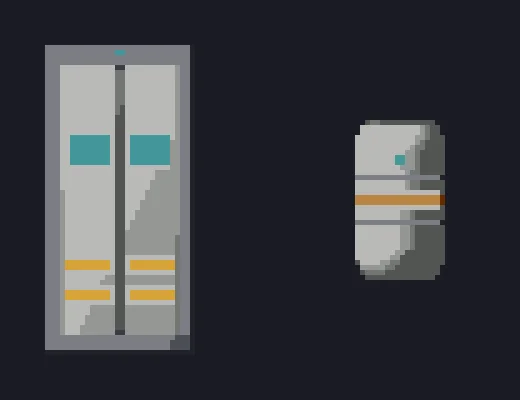
20 machines from 32×32 to 64×64, every canvas a multiple of the tile grid so a machine drops onto the same floor the tiles build.
Which animations does Coriolis ship, and why only two?
An airlock cycle and a rotary joint spin, both 8 frames. Coriolis ships two animations rather than twenty because those are the two whose loops have been measured frame by frame: the door's leaves meet with zero gap when closed and its doorway clears to 100%, and the joint's lit band genuinely moves — 322 pixels change across the sweep, which had to be checked because the obvious way to implement a turn does nothing at all.
The palette check on a Coriolis animation is not "does every frame show the same number of colours". A closed door shows 11 and an open one 13, because an open door has a recess to show, and the build refused to write the pack over exactly that before the check was corrected. What matters is drift, and drift means the union over all frames exceeds the widest single frame.
Both loops. The joint is one drawing — nothing in its geometry moves between frames, only the implied light direction sweeps.
How is "100 distinct assets" verified rather than claimed?
By hashing every asset and refusing to build if two collide. The Coriolis build found two real duplicates and two pairs that were distinct but too similar to be worth two names, and the fix for each was a redesign rather than a threshold change.
- Two duplicates. surf_plain was the same pixels as zone_00 — correct, because a transition family's empty tile is the other terrain's full tile. battery_rack had the same silhouette as cryo_pod: two 32×64 solid boxes. The rack was reopened into posts and shelves, which is the better drawing anyway.
- Two near-duplicates. A crate and a locker differed by 5% of their ink; a sack and a jar by 10%. Two icons that differ by five percent are one icon printed twice, however different their names are.
- Two hash spaces, not one. An icon's identity is its outline; a tile's is its surface, because a tile that is not a transition is a full opaque square whose alpha carries no information. Using the wrong key is silent in both directions: hashing 40 tiles on alpha reported 24 duplicates that were not duplicates.
40 icons in four families of ten. No family has members that differ only by a parameter — every member differs by a silhouette operation, because eight gears that differ only in tooth count read as one icon printed eight times.
What does the Coriolis pack deliberately not do?
Coriolis states its limits in the README rather than leaving them for a review. Three of them are structural and will not change in Part Two.
- No soft glows. Emissive parts are hard-edged bright palette entries. The export is indexed PNG with binary alpha and cannot fade one — which is also how most pixel-art sci-fi actually works, but it is a limit and it is stated.
- Eighteen machines are static. Only the two measured loops ship as animations.
- Each surface marking is its own socket. A marking crosses its own edges in order to stay periodic, so a hazard zone has a boundary rather than blending pixel-perfectly into bare plate. That is a design statement; pretending otherwise would be the lie.
Frequently asked questions
Will Coriolis tiles line up with Part Two of the series?
Yes. Part Two of the Orbital Series uses the same 32-pixel grid, the same palette and the same corner-tile scheme, so both sets drop onto one floor without a seam between them. That is why the scheme is corner-identified rather than edge-matched: compatibility is a property of the data, not an agreement between two packs.
What engine settings does a Coriolis import need?
Unity: Sprite (2D and UI), Filter Mode Point, Compression None, 32 pixels per unit, mip maps off. Godot 4: Default Texture Filter Nearest, mipmaps off, lossless compression. Scale by whole numbers only — a fractional scale breaks the pixel grid whatever the other settings say.
Does the pack include spritesheets and atlases?
Yes. Icons ship as 40 individual indexed PNGs plus one atlas with Aseprite-format JSON, tiles as 40 PNGs plus one atlas per family, and animations as frames, strips with JSON and GIF previews. Machines ship as individual files only, on purpose: they run from 32×32 to 64×64, and an atlas of mixed cells is a texture with holes in it plus a JSON the importer has to be told to ignore.
Is the 31-colour palette a real constraint or a description?
A constraint. Every file is PNG-8 indexed against one table assembled from the finished art, so it is structurally impossible for a file to hold a colour outside it. A promise checked by eye is a promise that will be broken by file 300.
Can I use Coriolis in a commercial game?
Yes, in any number of commercial and non-commercial projects. Modify and recolour freely; credit is welcome but not required. You may not resell or redistribute the assets themselves as art. The licence text ships inside the zip and matches this page word for word.
Was any generative AI used to make the art?
No. Every asset is produced by authored shapes run through a deterministic renderer, and the build is reproducible: the same code gives the same sha256. The archive is zipped in fixed order with a fixed timestamp, so a changed checksum means the art changed and not that the compressor did.
Why is the pack called Coriolis?
The Coriolis effect only exists because something is rotating. It is a name that cannot be true of a stationary object, which is the point of a pack whose loops close exactly and whose joint turns from a single drawing.
About this build. Coriolis is produced with Boneglass, an open procedural pixel-art tool written for this series. Every number in this article comes from the build log or from a measurement script in the repository, not from an estimate: 512 four-tile arrangements checked, 35 faults caught before release, 399 unit tests green at time of writing. The tile family, the mask generators, the ornament library and the checks live in the tool; the catalogue lives in the pack.
Author: najjar320 · Pack version 1.0.0 · Published and last updated 2 August 2026 · Sources: Lagae & Dutré, ACM TOG 25(4) 2006; Kopf et al., Recursive Wang Tiles for Real-Time Blue Noise, SIGGRAPH 2006; the Coriolis build log.
 GetAssetPack