GetAssetPack

D16 Sigmund 2

D16 Sigmund 2
Type
Sounds

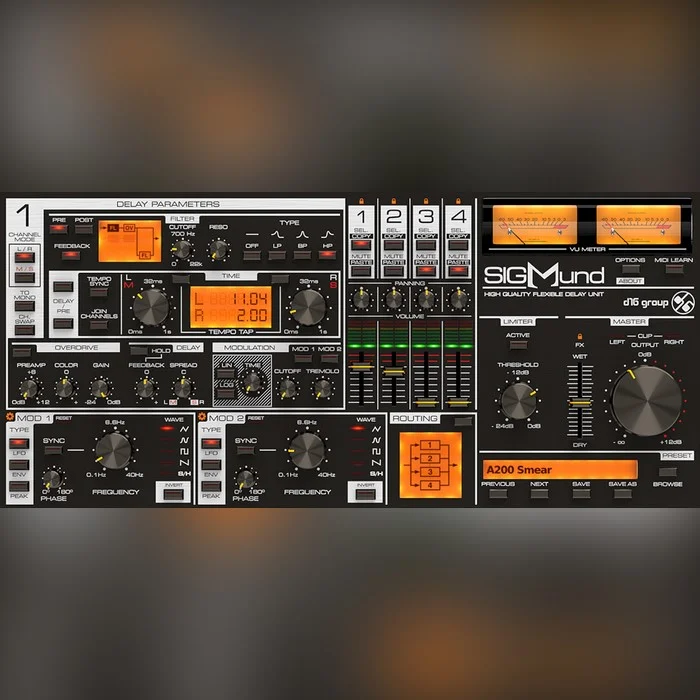
Four independent delay units and two modulators provide sound shaping for music and sound design.

- Incredible degree of sound-shaping freedom Sigmund is far from just another delay: it consists of four discrete delay units, each with its own, independent set of parameters offering an incredible degree of sound-shaping freedom. There's an ancient saying, often attributed to Aristotle: The whole is greater than the sum of its parts. With Sigmund, this is especially true: each of the delay lines has complementary modules built-in, independent from the feedback loop: But that's not all: Sigmund has two general-purpose Modulators which can be used to auto-modulate some of the delay lines' internal parameters. There are three different modes a Modulator can operate in: LFO - Used subtly on-time parameter can delicately bring a sound to life, to add gently flowing, modulated warmth reminiscent of the analog delays of yesteryear. At extreme settings, the LFO is capable of twisting the input signal utterly beyond recognition and into what you might expect transmissions from an alien civilization to sound like! Envelope - In combination with built-in Transient Detector gives you a very powerful tool; when applied on amplitude allows to freely shape sound’s dynamics to control how it blends in the whole mix. Peak follower - It’s a must-have for a Modulator; nothing else will do such expressive wah-wah effect, when filter cutoff is influenced by. Surely in the hands of skilled sound designer it will have many other applications beyond that. This all adds up to an immensely powerful architecture, the potential of which can be explored nearly endlessly and often with hardly predictable outcomes.

Available on

Search by image

Upload a reference to find previews with similar colors, contrast, and detail.

D16 Sigmund 2

D16 Sigmund 2
A Sound Effect
Sounds
License not indexed
  • i Check the terms on the original listing.
Show full terms

- Incredible degree of sound-shaping freedom Sigmund is far from just another delay: it consists of four discrete delay units, each with its own, independent set of parameters offering an incredible degree of sound-shaping freedom. There's an ancient saying, often attributed to Aristotle: The whole is greater than the sum of its parts. With Sigmund, this is especially true: each of the delay lines has complementary modules built-in, independent from the feedback loop: But that's not all: Sigmund has two general-purpose Modulators which can be used to auto-modulate some of the delay lines' internal parameters. There are three different modes a Modulator can operate in: LFO - Used subtly on-time parameter can delicately bring a sound to life, to add gently flowing, modulated warmth reminiscent of the analog delays of yesteryear. At extreme settings, the LFO is capable of twisting the input signal utterly beyond recognition and into what you might expect transmissions from an alien civilization to sound like! Envelope - In combination with built-in Transient Detector gives you a very powerful tool; when applied on amplitude allows to freely shape sound’s dynamics to control how it blends in the whole mix. Peak follower - It’s a must-have for a Modulator; nothing else will do such expressive wah-wah effect, when filter cutoff is influenced by. Surely in the hands of skilled sound designer it will have many other applications beyond that. This all adds up to an immensely powerful architecture, the potential of which can be explored nearly endlessly and often with hardly predictable outcomes.

Four independent delay units and two modulators provide sound shaping for music and sound design.

View original listing